It was practically a miracle.
It would certainly go down in the history of Mars as the “Miraculous 7 Minutes”.
This is the story of the two girls who set it all in motion.
That is the promise that Carole & Tuesday gives, and it certainly caught my eye when I was planning out my watch list for this season. It sets up a plausible future for our world (although it’s set on Mars), in which culture is wholly produced and directed by artificial intelligence, and the population are happy to be passive consumers.
Now I’ll admit, I knew going into Carole & Tuesday that no matter what, I would probably have a good time going in. The narrative trappings of two main characters of the same gender meeting each other and coming of age with music as a heavy theme is the foundation of two of my favourite classic animes, Nana and Sakamichi no Apollon. Each of them have their own special qualities. Nana dealt with extremely soul-crushing and heavy aspects of adulthood, where both main characters had to navigate their own individual entangled webs of romance, infidelity, and chasing shattered dreams, while at the emotional core of the show struggling to keep their friendship together as they are forced to hide things from each other. Apollon dealt instead with two male friends and their journey through adolescence, bound by their mutual love for jazz music, and constantly at odds with each other. It also touches on the societal upheavals of post-war Japan, as one of the main characters is caught between the crossroads of his traditional, semi-aristocratic family and the American influence that jazz represents.
In much the same way, Carole & Tuesday hearken back to traditional shoujo coming-of-age tropes; one headstrong girl, one more traditionally feminine girl, teaming up against the world. It’s not a new concept, but there are a few key aspects that manage to set this show apart. Firstly, by introducing parental issues into the girls’ characters, it adds another dimension to their characterizations. Carole grew up as an abandoned orphan and never knew who her parents were, so she had to learn to fend for herself at a young age. Tuesday grew up the failed daughter of a semi-aristocratic family, in the shadow of her older brother and especially her big-name politician mother, which lends to the overall feeling of a nervous princess-type that we get from her character. In both cases, their respective backstories ground their character traits, and show how they became flaws on their own; Carole is too headstrong to be honest with her feelings, and Tuesday is too deferential and self-effacing to be honest with hers.
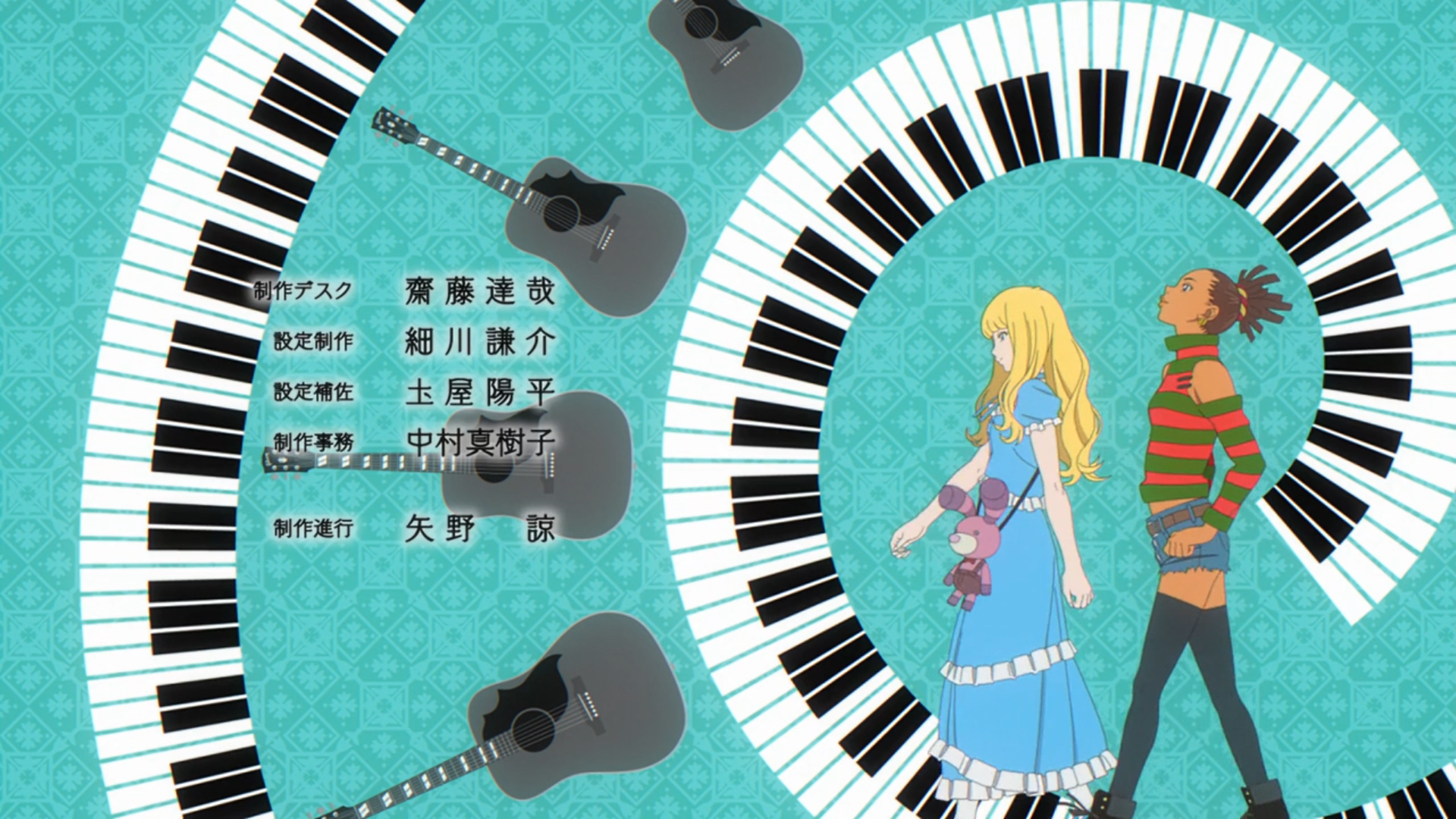
If you’ve watched Apollon, you’d immediately recall that this theme was explored there, where Kaoru had to deal with an oppressively traditional family that had very strict expectations set of him, and Sentaro came from a family with irresponsible parents. In many ways, Kaoru is like Tuesday, and Sentaro is like Carole. It’s no surprise, really, since the Chief Director Shinichiro Watanabe also worked on Apollon.
Beyond the main characters themselves, however, the very American way in which the world was conceptualized lends itself to easily the most diverse cast in any anime I have seen yet – it has diversity in race, gender identity, and sexuality, among others. It was in this great diversity in the entire cast of the show that really excited me, and the characters that I found most personally striking would be the mother-daughter pair of Dahlia and Angela, as well as Cybelle.
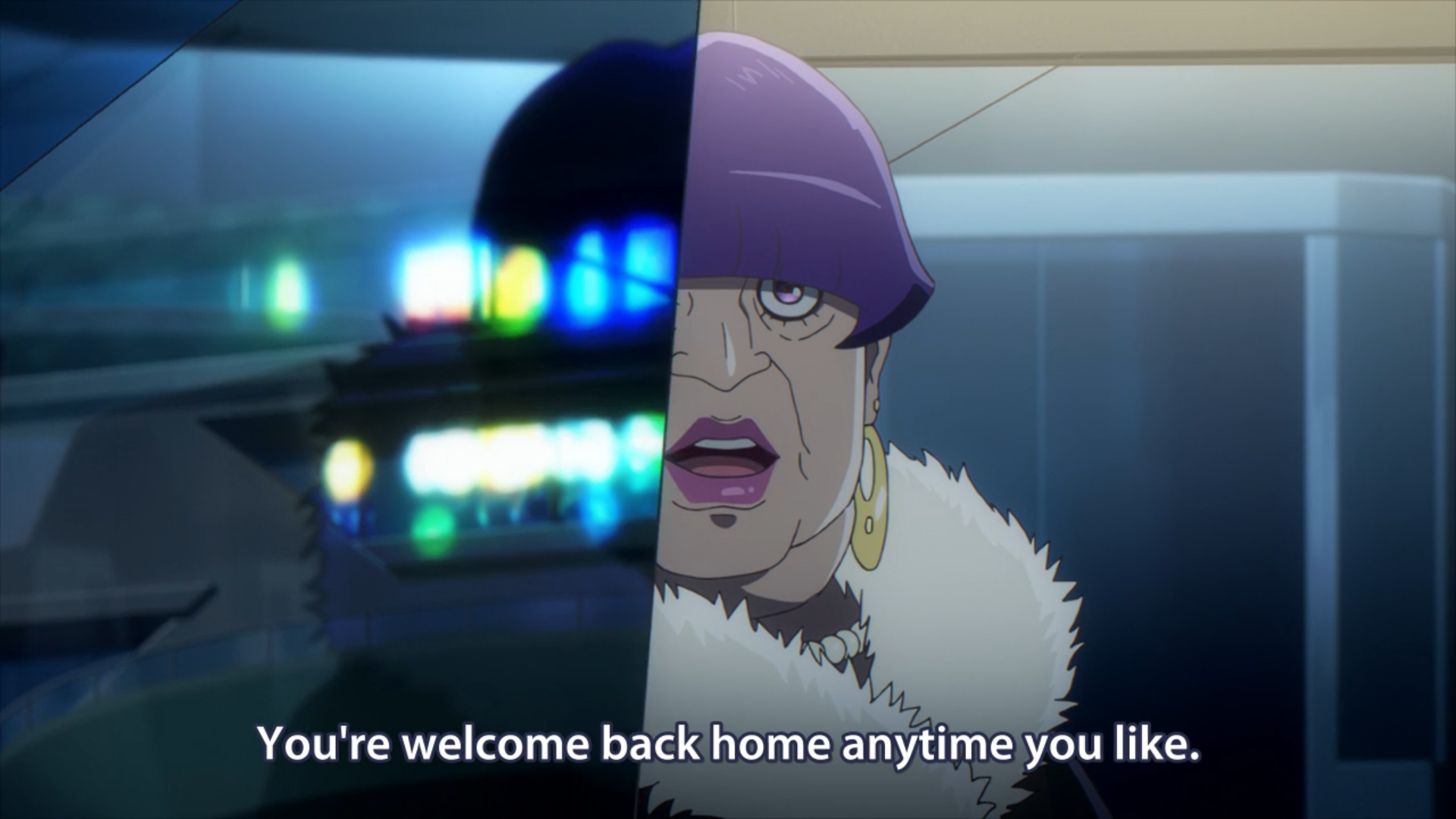
When we are first introduced to Dahlia, it is as the guardian and manager of the girl whom the show flags as eventually becoming the rival character. Unlike our main characters, who have to construct their musical career from scratch, Angela is already an established model, and hires an AI engineer to engineer the perfect song for her to sing so that she can break out onto the scene to fulfill her dream of being a pop star. We are given no context as to who Dahlia is at the beginning of the show; it is merely stated that she exhibits “Martian androgyny”, very blatantly a stand-in for being (most probably) non-binary transgender. Within this context of an androgynous individual with female dressing and mannerisms but a male-typed body and voice, the audience is led to unease at how touchy she is with Angela. The juxtaposition of the character’s appearance to their other aspects of identity are played up to bring out an inner sense of dissonance and unease that further plays up the evil nature of these characters, especially so because anime has classified assigned male at birth (AMAB) androgynous characters as either malevolent, or a laughingstock. Unfortunately, the show does pull on this trope exactly once; but for a scene so surreal I’m willing to forgive it.
What really turned it around was the realization halfway through the show that, while Angela was to be the rival of Carole and Tuesday, she was neither evil nor their enemy, and Dahlia was not a malevolent pervert manager. In fact, in a moment that pulled the rug out from under me, it was revealed that Angela didn’t call Dahlia “Mama” for any reason other than the fact that Dahlia really was her mama. Dahlia was none other than her dad, who had been stricken with “Martian androgyny”, and while Angela respected her new Mama, there was a sense of unease. This revelation, coupled with a picture of the old Dahlia with Angela hung up in Angela’s room, overturns the dynamics that we had expected from these two characters.
There have been many works exploring either being the parent of a transgender child (watch Euphoria!!), or being a transgender parent with a child who has no idea what is going on. I have personally never seen a piece that has attempted to explore what it is like for a child to have a parent transition halfway through their childhood, and Carole & Tuesday does its best to put forward the confusion that Angela feels. There is no ill will towards Dahlia; in fact, the two still seem to be close, on the surface of it. However, simmering just underneath is a difficult-to-unpack cocktail of emotions. Dahlia is trying to reconnect with her daughter, because while the bonds of the past were well and truly broken when Dahlia changed, they were already really close as a family, leading us to see how truly hollow their familial relationship to each other is. Angela doesn’t fault Dahlia for it, and even respects her by calling her “Mama”; but there are unresolved feelings of anguish underpinning her decision to continue living on her own.
And it’s not as if this whole side-story is completely irrelevant; whether you are supportive of trans rights and representation or not, you will feel more sympathy for Angela. In a masterful stroke, by designating Angela and not Dahlia as the centerpiece of this side-story, the director has given us a credible, humanized, and sympathetic rival to our titular duo, which makes it that much harder to pick one side over the other in their competition.
Lesbians also feature prominently in Carole and Tuesday, and the show does well to set aside actual romantic love between two women, and the very close friendship that the main characters have. I’d like to submit for evidence this scene, early into the anime.

This scene, where Carole and Tuesday watch the ex-wife of their band manager smooch it up with her new wife, is notable because in many anime with two female leads, there will be a sizeable faction of (mostly male) fans who contort the deep friendship that the two inevitably form into something more romantically-themed. By having our protagonists literally watch actual lesbian dynamics in front of them and not follow suit in any way or comment on it in any way, it separates them from the overtly lesbian couple on the screen. I’m sure there will be people who ship our protagonists regardless, but the show has made a stand against it instead of turning it into fanservice/queerbait, or allowing their fans to do so themselves.
There exists in the anime community a fetishistic view of psychotic girlfriends, or “yanderes”, by a large number of male viewers. I assume that there’s a sense of bewilderment and jealousy that a girl could be so crazily in love with someone that they would resort to either hurting themselves or others around them in ill-fated attempts to get to the target of their affections. This strange phenomenon is evident in the case of the real-life Japanese girl who stabbed her crush, and the establishment of a thankfully unsuccessful GoFundMe to bail her out. At the same time, the anime community fetishizes homosexual themes in yaoi and yuri anime/manga (yaoi/boys’ love for female viewers, and yuri/girls’ love for male viewers), to the extent that shows featuring predominantly homosexual themes will many times choose to fetishize their characters and their relationships rather than do any actual exploration into the themes. Is it any wonder that there exist a large number of yaoi/yuri viewers who remain adamantly opposed to same-sex marriage?
Cybelle, a yandere lesbian, represents an intersection of both, but it would be really hard for the layperson to justify her actions and fetishize those aspects of her. She is presented to be hopelessly infatuated with Tuesday, and intent on taking Carole’s place as her partner. It’s all fun and games until Tuesday eventually works up the courage to tell Cybelle about her desire to stick with Carole, and Cybelle decides to sabotage her performance. It makes it nearly impossible to actually sympathize with her, unless you really, really lean into your fetishization of these two personality traits.

Presenting a (decidedly one-sided) lesbian romance and making it just as toxic as a heterosexual romance is, to me, stellar representation. So is presenting the respectful but conflicted response of a child to her for-the-most-part post-transition parent. Shows featuring casts with diverse identity like Carole & Tuesday, Zombieland Saga, and Yagate Kimi ni naru (all of them came out in the past 2 years!!) is as exciting from a narrative standpoint as it is from the standpoint of someone who does want to see more effort being put into wider representation, and the blossoming of a medium with so much potential through its exploration of social issues that are actually rocking Japan today.
At the time of writing, Carole & Tuesday is only halfway through; with 13 episodes to go until the entire season is complete, watching this show is a genuine highlight of my week, and I simultaneously want it to never end and also can’t wait for it to be over so that I can fully unpack and decompress my thoughts about it. In the meantime, I will be following their Instagram and Spotify accounts to keep track of their beautiful, soul-wrenching music, and waiting for them to finally show us the Miraculous 7 Minutes on Mars.
 Belle's Hell