
When he returned for his appointment, I eagerly asked Tom how the medicines had worked. He told me he hadn’t taken any of the pills. Trying to conceal my irritation, I asked him why. “I realized that if I take the pills and the nightmares go away,” he replied, “I will have abandoned my friends, and their deaths will have been in vain. I need to be a living memorial to my friends who died in Vietnam.
I was stunned: Tom’s loyalty to the dead was keeping him from living his own life, just as his father’s devotion to his friends had kept him from living. Both father’s and son’s experiences on the battlefield had rendered the rest of their lives irrelevant. How had that happened, and what could we do about it? That morning I realized I would probably spend the rest of my professional life trying to unravel the mysteries of trauma. How do horrific experiences cause people to become hopelessly stuck in the past? What happens in people’s minds and brains that keeps them frozen, trapped in a place they desperately wish to escape? Why did this man’s war not come to an end in February 1969, when his parents embraced him at Boston’s Logan International Airport after his long flight back from Da Nang?
Tom’s need to live out his life as a memorial to his comrades taught me that he was suffering from a condition much more complex than simply having bad memories or damaged brain chemistry —or altered fear circuits in the brain. Before the ambush in the rice paddy, Tom had been a devoted and loyal friend, someone who enjoyed life, with many interests and pleasures. In one terrifying moment, trauma had transformed everything.”
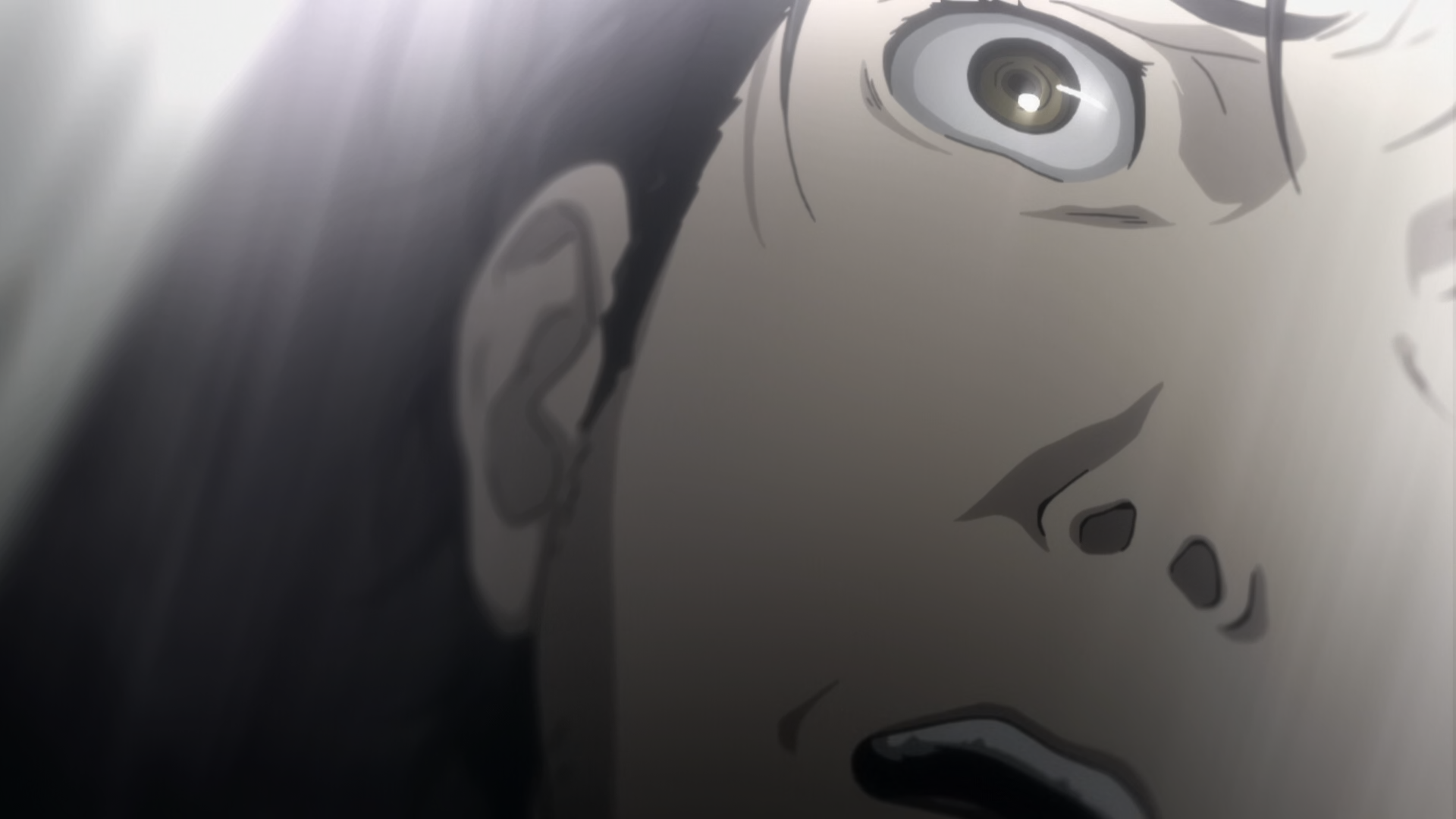
One of my favorite stories in fiction is The Metamorphosis by Franz Kafka. It is peculiar in a particular way: the events in the story are almost peripheral to the actual meaning underpinning the story. In The Metamorphosis, the salesman Gregor Samsa wakes up one morning transformed into an enormous insect. Yet, his concern and the main story elements do not deal primarily with his transformation into an insect in and of itself, but rather its implications for the world around him. One of Gregor’s first thoughts is to call in sick for work. He ponders how his family will manage without him around as the sole breadwinner supporting them. Not much attention is paid to the fact that Gregor is now a huge insect, least of all by Gregor himself. This is because this is not an Animorphs novel; the metamorphosis we observe here is not to be treated purely as a literal story event, but rather as symbolic. Many have, over the years, attempted to plug at interpretations for The Metamorphosis. One of the more popular modern interpretations is that the crucial metamorphosis occurring is that of Gregor’s sister, Grete, from a girl into a woman, and her assumption of responsibility as the primary male caretaker of the family becomes grotesque, wretched, and without salvation. It is also possible to read the story with the idea that Gregor is still a human, and his physical degeneration into an insect’s body is a function of how he views himself as a professional worker.
In the same way, I don’t believe that calling Steins;Gate “that anime about time travel” is entirely accurate. Time travel plays a significant role in the story, and it is around the theme of time travel and the conspiracy theories regarding it that the core story beats revolve. However, saying that Steins;Gate was about time travel would be the same as saying Neon Genesis Evangelion was, in fact, about giant robots defending Earth against kabbalistically-derived aliens. No, Evangelion is decidedly an anime about loneliness and depression, and so ultimately while the plethora of information available on the NGE wiki about how the various entities and story patterns tie in to Jewish mythology are useful (if you’re a nerd), knowing that the supercomputers in the underground base are named after the three wise men who visited Jesus or that the Central Dogma deals with the flow of genetic information within biological systems does not in any way help one’s understanding of the central conflict within Evangelion. In the same way, I believe, arguing about time travel paradoxes and inconsistencies within the Steins;Gate timelines is ultimately quite pointless in trying to pin down exactly what Steins;Gate is, at least from my point of view.
Ultimately, Steins;Gate is a story about trauma.
In many ways, time travel is the most perfectly ironic story device to use to illustrate trauma. These days, the word “trauma” is bandied about quite often without a true understanding of what it really implies for the individual who is experiencing this trauma. We all know the tropes of trauma – nightmares, flashbacks, triggers, etc. that have been expanded upon to death in the media. We can recognize it in Okabe Rintarou’s eyes every time he witnesses the death of Shiina Mayuri, or is confronted with his decision to let Makise Kurisu die in Steins;Gate 0. But true appreciation of the beauty of Steins;Gate‘s storytelling only comes with a good reckoning of exactly what trauma is. It’s such a perfect fit that this is the reason why I chose Steins;Gate to headline the 4-part series on trauma’s representation in anime, with each segment exploring a different aspect of trauma, and how it deals (or fails to deal) with recovery and reconciliation.
After about three months in country Tom led his squad on a foot patrol through a rice paddy just before sunset. Suddenly a hail of gunfire spurted from the green wall of the surrounding jungle, hitting the men around him one by one. Tom told me how he had looked on in helpless horror as all the members of his platoon were killed or wounded in a matter of seconds. He would never get one image out of his mind: the back of Alex’s head as he lay facedown in the rice paddy, his feet in the air. Tom wept as he recalled, “He was the only real friend I ever had.” Afterward, at night, Tom continued to hear the screams of his men and to see their bodies falling into the water. Any sounds, smells, or images that reminded him of the ambush (like the popping of firecrackers on the Fourth of July) made him feel just as paralyzed, terrified, and enraged as he had the day the helicopter evacuated him from the rice paddy.
Maybe even worse for Tom than the recurrent flashbacks of the ambush was the memory of what happened afterward. I could easily imagine how Tom’s rage about his friend’s death had led to the calamity that followed. It took him months of dealing with his paralyzing shame before he could tell me about it. Since time immemorial veterans, like Achilles in Homer’s Iliad, have responded to the death of their comrades with unspeakable acts of revenge. The day after the ambush Tom went into a frenzy to a neighboring village, killing children, shooting an innocent farmer, and raping a Vietnamese woman. After that it became truly impossible for him to go home again in any meaningful way. How can you face your sweetheart and tell her that you brutally raped a woman just like her, or watch your son take his first step when you are reminded of the child you murdered? Tom experienced the death of Alex as if part of himself had been forever destroyed—the part that was good and honorable and trustworthy. Trauma, whether it is the result of something done to you or something you yourself have done, almost always makes it difficult to engage in intimate relationships. After you have experienced something so unspeakable, how do you learn to trust yourself or anyone else again? Or, conversely, how can you surrender to an intimate relationship after you have been brutally violated?

The key aspect of trauma which Steins;Gate explores is how trauma locks one in time. In order to be able to make sense of one’s life, one must be able to assemble the events of one’s life into a coherent narrative structure. This is the normal method of weaving experience into memory for human beings, and it helps us to create the psychological foundation for our daily functioning by establishing a firm sense of identity and place. However, it is quite easily disrupted; what happens when an experience is not amenable to assimilation whatsoever? We most frequently encounter this situation in the most wretched depths of the human experience. War is an intensely stimulating and terrifying experience, with so much in the way of sensation but not much in the way of coherence. So is experiencing sexual assault. The defiling of human life and individual dignity strikes at the heart of an individual’s psyche, and is near-impossible to weave into one’s coherent autobiographical narrative. “The self of the traumatised victim cannot remember itself to itself, and cannot imagine itself whole… yet trauma is a difficult condition to understand because it involves both an inability to forget, with an uncontrollable past making terrifying intrusions into the present, and an inability to assimilate the past within a broad duration across time because what cannot be realised as such, acts as it were in utter scorn of the victim’s present and future needs. Trauma embraces both radical cross-temporal discontinuity, and radical temporal continuity heedless of the biographical continuousness of change.” (Keightley & Pickering, 2012) Time travel, then, can be construed as a very literal representation of time breaking down for traumatized individuals.
Broadly speaking, we can construct the whole Steins;Gate canon as one great exercise of the Hero’s Journey, as with anything else. I feel it is necessary to back up this connection with the understanding that it’s really not that uncommon to infuse a reading of the Hero’s Journey together with trauma in conducting character or story analysis. In fact, there’s an entire YouTube channel dedicated to doing just that, and he does a stellar job at it (I appropriated his most commonly-used reference for analyzing representations of trauma in media for this piece, so there’s that). Additionally, the Hero’s Journey is in itself a descriptive narrative structure which we use to analyze character development in fiction, and seems quite apt for analyzing the (auto)biographical narrative of Okabe Rintarou. I believe that Steins;Gate 0 is also crucial in completing one’s understanding of Okabe’s journey, since the crucial link of the Hero’s Journey, the Abyss, occurs within Steins;Gate 0, although regrettably the anime is greatly lacking in many of the aspects present in the game. The Hero’s Journey, also known as the Monomyth, was originally developed by Joseph Campbell as a way to deconstruct and explain the similarities between the great world myths in many pre-modern mythological narratives involving great figures. He summarizes it in his book, The Hero with a Thousand Faces (1949), as such: “A hero ventures forth from the world of common day into a region of supernatural wonder: fabulous forces are there encountered and a decisive victory is won: the hero comes back from this mysterious adventure with the power to bestow boons on his fellow man.” I reference the stages of the Monomyth quite a bit, so here’s a quick guide on what each stage entails.

Okabe begins his journey as an extremely carefree individual, who spends his days in the lead-up to attending university tinkering with things and hanging out with his two closest friends, Hashida Itaru and Shiina Mayuri. He is called to adventure by Professor Nakabachi’s conference on time travel. Through a miracle of coincidence, he manages to spark the time-traveling function on the Phone Microwave, thus saving the life of Makise Kurisu and turning her into his mentor, upon which he crosses the threshold. The first half of Steins;Gate, while boring and seemingly draggy to most people, really is not to me upon reflection. Okabe’s carelessness with his words and behavior once he has crossed the threshold into the unknown world of time travel cements his group of allies and his group of enemies. It is a masterful bait and switch; where Okabe has only just entered into the world of the unknown, the audience is brought to believe that he has already come back a conquering hero, with the amount of happiness he doles out to those close to him. In reality, Okabe is travelling even further into the Belly of the Whale, ignorant of his pending symbolic death and rebirth until the moment Mayuri lays dead at his feet. The imagery of the clock having stopped working is particularly haunting as a reflection having been reborn into this unending cycle. This traumatic event disrupts Okabe’s narrative of his self, and he is reborn as the eternal time traveller that is locked in time. From the moment after he sees Mayuri’s first death, every single decision is framed in a purely utilitarian calculus – how will this help to save Mayuri?
Now firmly ensconced in the terrifying world of the unknown, Okabe must defeat a number of trials. Being that this is a story of time, he must fight against time itself. He must figure out how time travel works, and how to undo his meddling with time. This is one of the core emotional struggles of Steins;Gate would not exist, that of; having to make the decision to take away from each and every single one of your friends the happiness which you have managed to, through the force of miracle, grant them. It is knowing that you could have given your friends a better life, and that you have seen that better life and their happiness, but you must reverse that decision. While he is aware, conscious, cognizant of the way in which his acts are returning his friends to their previous, less happy states, at this moment in time he is unable to care, because he is on a crusade to save Mayuri, in which everything else is secondary. He coldly logs how much time each reversal manages to save Mayuri. He waits for her to actually die before his eyes to confirm his hypothesis. Above all, while he enlists Kurisu’s help, he is unable at this moment in time to connect with her or think about the consequences and implications of his actions. Succumbing to the temptation of giving up, or enjoying another friend’s happiness with them as you are able to in the visual novel, marks the ignominious end of Okabe’s journey, and his inability to ever be able to return to his original state, or to continue weaving his experience into memory. A premature end to the journey means Okabe is now entirely lost, stranded within his broken sense of time.

Maybe the worst of Tom’s symptoms was that he felt emotionally numb. He desperately wanted to love his family, but he just couldn’t evoke any deep feelings for them. He felt emotionally distant from everybody, as though his heart were frozen and he were living behind a glass wall. That numbness extended to himself, as well. He could not really feel anything except for his momentary rages and his shame. He described how he hardly recognized himself when he looked in the mirror to shave. When he heard himself arguing a case in court, he would observe himself from a distance and wonder how this guy, who happened to look and talk like him, was able to make such cogent arguments. When he won a case he pretended to be gratified, and when he lost it was as though he had seen it coming and was resigned to the defeat even before it happened. Despite the fact that he was a very effective lawyer, he always felt as though he were floating in space, lacking any sense of purpose or direction.
The only thing that occasionally relieved this feeling of aimlessness was intense involvement in a particular case. During the course of our treatment Tom had to defend a mobster on a murder charge. For the duration of that trial he was totally absorbed in devising a strategy for winning the case, and there were many occasions on which he stayed up all night to immerse himself in something that actually excited him. It was like being in combat, he said—he felt fully alive, and nothing else mattered. The moment Tom won that case, however, he lost his energy and sense of purpose. The nightmares returned, as did his rage attacks—so intensely that he had to move into a motel to ensure that he would not harm his wife or children. But being alone, too, was terrifying, because the demons of the war returned in full force. Tom tried to stay busy, working, drinking, and drugging—doing anything to avoid confronting his demons.

Steins;Gate 0 is, in many ways, the core of our analysis of Okabe’s trauma. After all, Steins;Gate 0 happens in the small (big?) space in time at the end of the mainline series, one where Okabe is unable to bring himself to go back and save Kurisu one last time. His trauma is shifted from the moment at which Mayuri is killed by the Rounders, to the moment where he accidentally stabs Kurisu in his attempt to save her, and with Mayuri defending him at his mental breaking point, he abandons his quest, and is imprisoned within this choice. It is for this reason that the entirety of Steins;Gate 0 situates itself as Okabe’s experience in the Abyss, and his Apotheosis.
Throughout the introduction of Steins;Gate 0, he is largely numb, neutered, and lacks any of his old boisterous personality – Mayuri notes with surprise at his attending a mixer, to which he responds that he was simply dragged along. Hououin Kyouma has died, and in its wake only a muted, introverted individual stands. Even with this general sense of listlessness about him, Okabe is driven by a singular goal – to attend Victor Chondria University, Kurisu’s old institution, and continue the work that she had done. The very first reigniting spark we see in him is when he attends the conference by Professor Alexis Leskinen and Hijayo Maho, in which he presents the same research on neurological pathways which underpinned the Time Leap Machine Kurisu had invented. Similar to war veterans who throw themselves into experiences reminiscent of their deployments in order to feel alive again, Okabe cannot help but to assist in the development of Amadeus as a tester, to communicate with the very individual who pins him in place to this timeline.
One of the most notable aspects of Steins;Gate 0 is that unlike the main series, Okabe is often incapable of bringing happiness to any of his friends, if he is even able of identifying what would make them happy at all. Where in the main series Okabe had to give them happiness before wresting it back from them, for much of the anime (and game) the world seemingly moves on around him. Despite the spectre of World War III hanging overhead, most of the events around him do not involve him – the development of Daru’s relationship with his daughter and future wife and the search for Mayuri’s daughter, Kagari, being the core of the excitement and action in the series. The revival of his agency, the power to influence the events going on in the world around him, seemingly comes only when Mayuri breaks the hinge upon which he is chained to this timeline – his decision to forgo saving Kurisu. This process begins when Mayuri expresses her regret at not encouraging Okabe to continue, and in fact shielding him from his own actions. From this point on, all the characters’ efforts mobilize around sending Mayuri to the past, in order to tell her past self to slap some sense into Okabe.
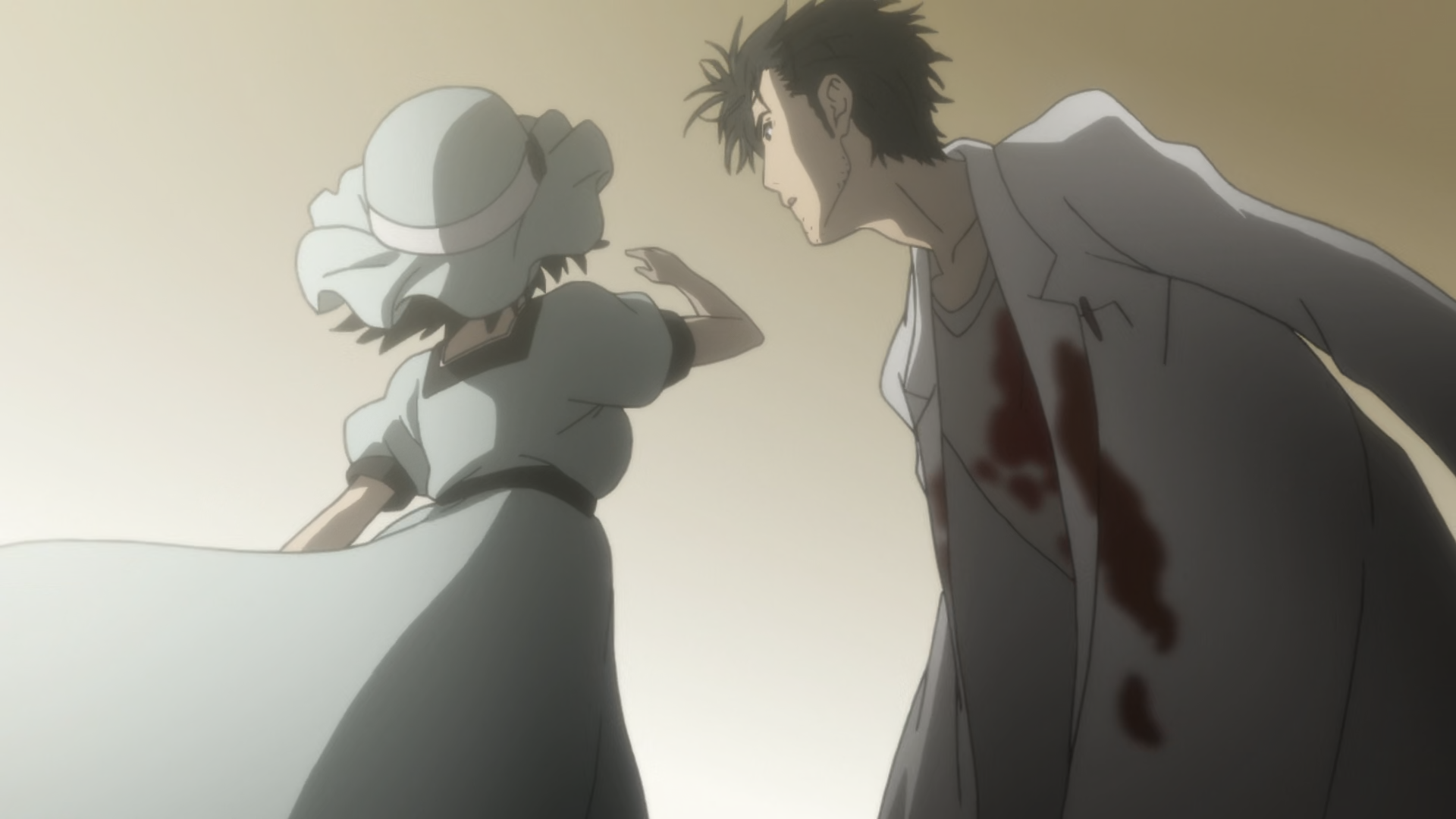
I suppose that the most common reading of this would merely be Mayuri telling Okabe to grow a pair, in a similar way that many Evangelion fans cry out “Shinji, get in the fucking robot!” in a gross misunderstanding of why, exactly, Shinji won’t get in the fucking robot and how that’s the entire crux of the story. I don’t think that this is the actual function of this process. The choice that kicks off the entire arc of Steins;Gate 0 in the original timeline is Mayuri’s choice to allow Okabe to rest, immobilized and inert, within the pool of his trauma. On the face of it, Mayuri is angry at Suzuha for placing the weight of the world upon Okabe. However, the weight of the world never really was what mattered to Okabe – it was the loss of agency he once again experienced when he realized that it was his hands that had, in fact, killed Kurisu. This encounter, and the realization of this truth, prevented Okabe from reaching out and attaining the greater resolve he needs in order to complete his journey. In effect, this is the purpose the Attractor Field Theory serves in the show, a device by which Okabe is deprived of agency and the ability to create meaningful change in the world. The false recognition that he could not meaningfully alter the world to prevent Kurisu’s death anymore is what, fundamentally, creates such a neutered character in Steins;Gate 0. So, Mayuri must break the hinge, by having him confront his trauma rather than seeking to escape it. The Apotheosis brings Okabe the resolution to face down the greater challenges ahead of him. I mean, the dude literally time leaps back from 2036 all the way to 2011 in order to get Mayuri to tell the other Mayuri to slap him in the face.
The fact that the Okabe of Steins;Gate and the Okabe of Steins;Gate 0 (Okabe Zero, for simplicity) are portrayed to be two entirely different people, unlike in the original series, is an interesting decision. At the end of Steins;Gate 0, Okabe Zero has mastered time travel to the point where he can travel back into the primordial space and rescue Mayuri and Suzuha. The resolve and understanding built up by Okabe Zero is transferred to Okabe the same way it all began: through a D-Mail. In this way, Okabe Zero rescues Okabe, and allows the latter to escape the world of the unknown. In effect, Okabe inherits the experiences of Okabe Zero. To quote Keightley & Pickering again, “In reflecting on [his] narrative, Hoffman calls it a project of translating backwards to retell [his] story in the language of the present. It is only in reimagining the past through this language that [he] is able to reconcile [his] successive selves to each other. It is not… a return to an origin, but a creative act of bringing into view the disparate strands of [his] own experience, enabling a movement ‘between them without being split by the difference’.” The memories and experiences of Okabe Zero are necessary as the final key element to weave all of Okabe’s experiences together, and give him the resolve to break the chains of time that bind him. Where in the main show Okabe’s moving across timelines was confined by his inability to break away from the memory of Mayuri’s death pinning him in time, in Steins;Gate 0 Okabe Zero reimagines his ability to move across time as a way to escape that which chains him, and it is this power which Okabe Zero finally bestows upon Okabe.
Activists in the early campaign for AIDS awareness created a powerful slogan: “Silence = Death.” Silence about trauma also leads to death—the death of the soul. Silence reinforces the godforsaken isolation of trauma. Being able to say aloud to another human being, “I was raped” or “I was battered by my husband” or “My parents called it discipline, but it was abuse” or “I’m not making it since I got back from Iraq,” is a sign that healing can begin.
We may think we can control our grief, our terror, or our shame by remaining silent, but naming offers the possibility of a different kind of control. When Adam was put in charge of the animal kingdom in the Book of Genesis, his first act was to give a name to every living creature.
If you’ve been hurt, you need to acknowledge and name what happened to you. I know that from personal experience: As long as I had no place where I could let myself know what it was like when my father locked me in the cellar of our house for various three-year-old offenses, I was chronically preoccupied with being exiled and abandoned. Only when I could talk about how that little boy felt, only when I could forgive him for having been as scared and submissive as he was, did I start to enjoy the pleasure of my own company. Feeling listened to and understood changes our physiology; being able to articulate a complex feeling, and having our feelings recognized, lights up our limbic brain and creates an “aha moment.” In contrast, being met by silence and incomprehension kills the spirit. Or, as John Bowlby so memorably put it: “What can not be spoken to the [m]other cannot be told to the self.”
I think Steins;Gate is a perfect analysis of the cross between time travel and trauma. In media, whenever we discuss time travel, it’s almost always discussing travelling to the past. We ask questions like: would you travel back in time to kill baby Hitler? If you could travel back in time to fix one of your mistakes, what would it be? We never really ask questions about traveling to the future. On some level, there is no frame of reference for what the future could look like, and so generally speaking there isn’t very much to talk about; however, time travel is mostly attractive to people because all humans inevitably live with regret. Abstracting a few levels, trauma really is just the natural conclusion of a life lived in regret, where one is so unable to move past an event or a period of time in their pasts that they become that neutered version of Okabe: numb, and unable to create effective change in their lives or on the world around them. Ultimately, every party who is interested in time travel in Steins;Gate is only interested in it to their own ends. In the visual novel of Steins;Gate 0, Vladimir Putin at some point uses a time machine to reverse the collapse of the Soviet Union, which is hilariously chilling given the knowledge that Putin sees the USSR’s collapse as the single biggest humiliation in Russia’s long history.
This, to me, is the reason why all time machine usage in Steins;Gate past the first few episodes of creating happiness for the other characters has the objective of returning to the original point in time. It’s not so much a case of wiping the slate clean here. Steins;Gate, and its alternate timeline, presents us with the thesis that regret is ultimately pointless without action by demonstrating its ultimate form, trauma, and its impact on the main (player) character. One might think that the final usage of the time machine to save Makise Kurisu would disprove this thesis, yet this final usage exactly captures how Okabe has now been freed from his trauma. Instead of being locked into a single space in time by his trauma, and doing everything he can to reverse that fateful decision, Okabe’s efforts to reach the ultimate timeline of Steins;Gate is, in fact, his rejection of the past and grasping of a new future. It is a radical new reassertion of his personal agency over his life and the universe around him, one that had been forsaken throughout the entirety of the series. Okabe flips the script, and instead of time mastering him, he has mastered time. As he finally forsakes time travel for good with his shining future secured, time begins to flow again.
Just like any other psychological issue, there really is functionally not a lot that can be “done” for sufferers of trauma in the conventional sense. Sure, you can attempt to medicate yourself, but the thing is that for a severe fracturing of the self – which is what trauma effects – any damage done is entirely internal, and therefore any remedy that you can apply must come from, and be applied to, the self. I’m not entirely sure if this knowledge is at all useful to you. Maybe you don’t suffer from significantly disempowering trauma, or perhaps this just sounds like another useless platitude. After all, if trauma is a temporally-disconnecting experience which disempowers you and robs you of your agency, whence cometh the means to draw our strength anew?
References
Keightley, Emily, and Michael Pickering. “Creative Memory and Painful Pasts.” In The Mnemonic Imagination: Remembering as Creative Practice, 1st ed., 165–93. Palgrave Macmillan Memory Studies. New York, NY: Palgrave Macmillan, 2012.
Kolk, Bessel van der. The Body Keeps the Score: Brain, Mind, and Body in the Healing of Trauma. New York, NY: Penguin Group, 2014.
 Belle's Hell