Introduction
You’ve heard of the American Dream, but have you heard of the Singapore Dream?
Singapore is not a country that is very often talked about by those not within corporate circles, and for good reason; civil society in Singapore is rather weak and funding for artistic endeavors never really compares well with those of other countries, even in the region. When I speak to people about where I come from, what people do tend to know Singapore for is its business-friendliness, its strategic geopolitical position and disproportionate military strength, and maybe sometimes its research and high-tech manufacturing.
Sometimes, Singapore makes it to the big screen, and it is all we will talk about amongst ourselves for a while. Life as a young person here can often be incredibly frustrating because of how much global connection we are lucky to have, but how little representation we have on the world stage. Once in a while, a YouTuber that’s big worldwide talks about Singapore and me and my fellow Singaporeans take notice and pounce. The latest global content producer that I can remember having been jumped on, in this case, is Nas Daily.
Nuseir Yassin, who runs Nas Daily and other associated content creation divisions now, is an Arab-Israeli vlogger whose claim to fame in Singapore is his videos over the course of 2019-2020 calling Singapore the “almost-perfect” country. Since then, he has moved to Singapore, set up a studio to support content creators here, and all in all seems to be living a pretty happy life. At the time, however, it caused massive backlash among Singaporeans, which is, in some ways, pretty funny. You’d think people would generally be happy to hear someone give their country that standard of praise; not in Singapore. “How dare you say our country is almost perfect, you foreigner who knows nothing of the struggles we go through?” Nuseir’s long dialogue with Singapore’s citizens to respond to this sentiment was illuminating.
In his videos and his interview on Talking Point, Nuseir does explain some of the problems that he has with Singapore society: the lack of a minimum wage and the treatment of foreign workers, to name a couple.
Despite all this, he says that Singapore is the best country for him to settle in. Perhaps this is because Singapore tops the world in terms of its environment for young children and working professionals alike. Perhaps because Nuseir’s own life experience has brought him to hundreds of countries around the world, he feels assured that he is making the right decision.
Ultimately, the reason many Singaporeans feel discomfited at Nuseir’s enjoyment of Singapore is that we simply don’t feel like we’re living in the paradise on earth that he describes.
Ajay Nair, Rice Media, 2019
Whenever I speak to people who want to move to Singapore, that generally describes what I hear. Singapore is a safe and stable country that is just relevant enough globally to attract multinational investment, but not relevant enough that it becomes the focal point of international crises. It is a good place to raise a family because of how clean and safe everything is. It is a good place for professionals because it is a cosmopolitan city that offers amazing amenities and easy connections to businesses across the world.
And you know what? For all the boring parts of Singapore, these are valid things to love about it, that I think most of us fail to appreciate until we try our hand at life outside our borders for the first time and understand just how sheltered we are in this tiny island. Take note of the word that I use here – “sheltered”. This is critical to understanding the aspect of the Singaporean condition I seek to lay out.
Singapore Dreaming
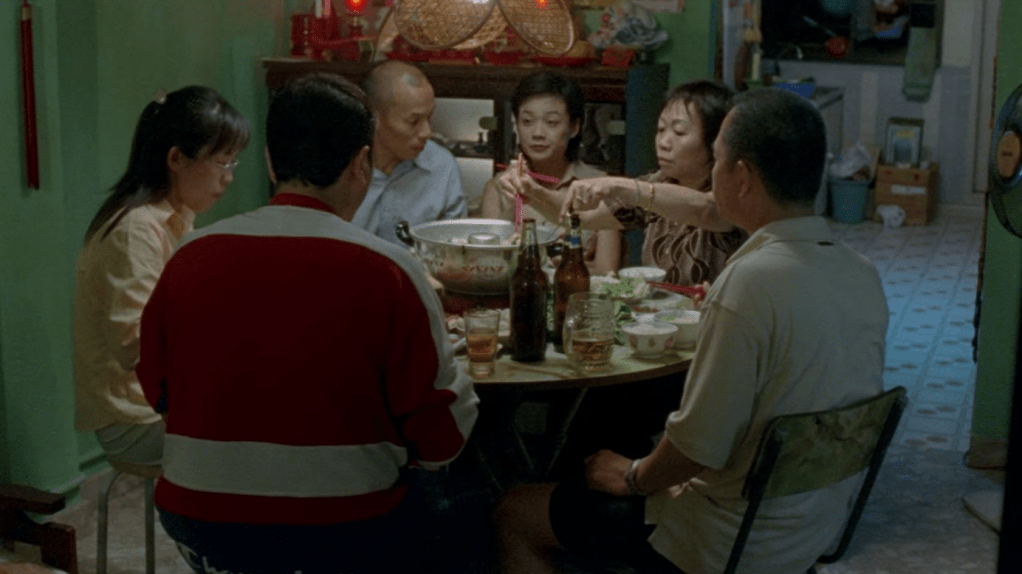
Singapore Dreaming is a film released in 2006. Its Chinese name, 美满人生, roughly translates to “a flourishing life”. Written, produced, and directed by the power couple of Colin Goh and Jocelyn Teo, it is set in Singaporean public housing and features the quintessential Singaporean family. The husband Poh Huat, the wife Siew Luan, the son Seng, the daughter Mei, and their childrens’ partners.
The first act of the movie serves to situate the family firmly as the spitting image of the middle-class Singaporean family. Poh Huat works as a paralegal clerk, a job at which he has worked for presumably much of his life with little upward mobility. Siew Luan is the spitting image of an old Singaporean mother figure whose presence is never felt and always taken for granted. Seng is the underachieving son in whom the family invested to go to college in the United States regardless, because boys have always been privileged over girls. Irene is his simple but loving fiancee from whom he borrowed money to go to college as well. Mei is the typical stressed young Singaporean working soon-to-be-mother. Chin Keong is her eternally henpecked husband who had left a career in the military and become an insurance agent with very little success on the horizon. Pinky is CK’s and Mei’s Filipino live-in domestic worker who does the housekeeping while CK and Mei are at work.
The core cast of the show are each animated by different typically Singaporean aspirations; for the working members, it is class aspirations, and for the women it is the prospect of marriage and a settled domestic life with the man they choose to support. The objects that symbolize the completion of these aspirations are the same across the aspiration type. The opening scene shows Poh Huat lounging at the swimming pool of a private apartment complex where he is waiting for his assistant to show up before he serves a notice to a resident. Much of his screen time is spent going on rants about how he belongs in a higher class than the one he is in. Mei and CK are later seen inspecting new private property developments despite knowing that they wouldn’t have the money for this upgrade anytime soon. At the same time, Siew Luan, Mei, and Irene all work towards the notion of supporting their husbands in a way that their husbands rarely reciprocate. What makes Mei so unique in this cast, then, is that she has to juggle both expectations simultaneously as a working soon-to-be-mother, a position that more and more Singaporean women find themselves thrown into and one that has always been under-discussed and under-appreciated in society at large. In this position, there is a constant tension between these two objectives – needing to urge their husband to spur himself on in order to fulfil the class aspiration, as well as the desire to support him in an emotional way as well.
The second act of the movie sees Poh Huat striking the lottery. With the money from the lottery, he does what the typical Singaporean of the early 2000s would have done; he buys a car for his son, issues him a credit card, and applies to a country club. Simultaneously, we are shown the difficulty Seng experiences in job hunting, and the pressures that Mei and CK face in their respective jobs. This act ends abruptly when Poh Huat dies of a heart attack sitting in the parking lot waiting to be interviewed for his country club membership.
The third and final act of the movie has the family grappling with the sudden death of their patriarch, with two significant points of tension; the funeral itself, and what to do with the money. It is customary in Singapore to hold open social events like weddings and funerals at the open spaces on the ground floors of public housing complexes – what we would call “void decks”. At these funerals, those who knew the deceased or their living family members come to pay their respects and provide customary small donations of money to the family. The funeral is notable for many reasons, but one of the most significant events is that Seng admits to not actually having graduated from his college. Later, it is revealed that Poh Huat had left all his assets to Siew Luan, who then decides to give most of the lottery money to Mei and Irene, and then leaves the house; it is implied that she returns to her old home before marrying Poh Huat.
A Brief Oneirocritique
Ultimately, the story of Singapore Dreaming is a middle-class story; the story of a family that aspires for mobility and whose ambitions eat them alive. It is a story that questions fundamentally the nature of the standard Singaporean aspirational script. It questions whether these things will make one happy, and responds that there is more to life to look for than the achievement of those goals. Not only does one have to reach for happiness after attaining those things, the attainment of those things may in themselves be poison pills as they cause you to waste precious time that you could share with people you care about. It is altogether a simple message put across with a lot of emotional weight for Singaporean viewers on whom the script has been so strongly imprinted.
I came across Singapore Dreaming as we do most things – on accident. I had no friends when I was 13, and so I took a trip down to the school library one day after class and, as I did any other day, selected a few books to read on my own. My school library used to have a room with rows of small TVs, in cubicles where you could borrow DVDs and CDs and watch them in the dark; it was always relatively silent since not many people used that service. I think the reason why this movie has stuck with me for over a decade since then is because of how much this story resonates with what I’ve personally seen growing up. But that’s just the thing – I am middle-class, and my family’s story is one of mobility. Singapore Dreaming is an amazing movie of the middle-class condition in Singapore. And it is exactly for this reason that I think I, and I would venture to say the writers, failed to consider just how much this movie lefts unsaid taken simply on its face.
The Battle Hymn of the Singaporean State
Returning to my usage of this word – “sheltered” – to describe Singaporeans. This word should conjure the image of a child who has no idea how to deal with the outside world because their parents have protected them from the vagaries of life to the extent that they have not had to think for themselves, and I do fully intend the sort of familial connotations that this implies. The Singaporean state is an incredibly paternal entity, and for all its failings I would ultimately ascribe to it benevolent intent. The Singaporean state is just like the typical Singaporean parent; incredibly restrictive, but ostensibly for the good of their own citizens.
For example, the Central Providence Fund (CPF) is a system that is in place for Singapore citizens that is lauded around the world but would likely face incredible resistance in Western democracies for the simple fact that it is a state-enforced savings programme. The state directly dips into your paycheck, takes out a chunk of it, and puts it away. There is no negotiation about it. You are able to use your CPF funds for multiple things – investment, mortgage, medical bills, school fees, just to name a few – but you are unable to directly withdraw from it. When you retire, the CPF is not returned to you as a lump sum; it is disbursed in small quantities depending on your life expectancy and how much you have left in it. On paper, the CPF system is incredibly effective at reducing the cost of sustaining retirees (if marginally unequal), since you are made to save for your own retirement. It is, however, something a father would do to teach a child the “value of money”.
Singaporeans are an incredibly sheltered people, and the paternalism of the State can then be directly tied to the phenomenon of helicopter parenting. Leaving the country for the first time, then, is not just a breath of fresh air – like the prep school girl raised in a Christian family encountering adult sexual content and practices for the first time (cough, me), the uncertainty with how to deal suddenly with the visceral freedom of adulthood combined with never having fathomed such desires and possibilities could exist before before can lead to explosive periods of adjustment. Singaporean media is rife with stories of Singaporeans who broke away from Singapore and write in glowing terms about how there was life beyond the gilded cage after all, while jaded older Singaporeans are content to scoff at those same articles muttering “Aiyah, everywhere also like that one lah.”
Thus, the stories of the creators – who are, I think, critical to understanding why this movie works the way it does – is crucial to any understanding of where this movie works and where it fails.
Who are Woo Yen Yen and Colin Goh?
Together with the movie, the directors, Jocelyn Woo and Colin Goh, published an interview-style essay titled “Paved with Good Intentions”. In it, they graciously tell the audience about their lives, how they fit into the Singaporean script, what the script was, and why it eventually drove them up a wall.
Colin Goh graduated in law from the University College London. He would hold a life-long passion for cartooning, and in a brief fit of passion pursue a stint cartooning in New York City before he finally attempted to settle in his life as a lawyer in Singapore. He would fail at this, and would eventually decide to break out of his monotone life as a lawyer in Singapore… By applying to study for a Master’s in Law at Columbia Law School. His calculus for doing so?
I then made a classic Singaporean evaluation: if I’m going to suffer, then by god, I’ll suffer for more money. I figured American lawyers make the most money, so that’s where I’ll go. I decided the fastest way to do this would be to do a one year Master’s degree, preferably in an Ivy League university, since it would provide me ingress into the American market.
Colin Goh, Paved with Good Intentions
His spouse, Jocelyn, followed a similarly Singaporean career track. Being trained as a teacher, Jocelyn laments the rigidity of the Singaporean pedagogy as well as the culture which that same pedagogy as well as the systemic incentives of the profession bred. Jocelyn would follow her husband to enroll in Columbia’s Teachers College. She would proceed to obtain multiple academic awards, all of which would be rendered entirely worthless to her when Singapore’s Minister of Education visited the college and had a short conversation.
I even met with our Education Minister when he visited Teachers College. Of the questions he asked me, two stood out: “When are you going back to Singapore?” and “When are you going to have babies?” It hit me that I had never spoken to the Minister when I was teaching in Singapore. I wondered: am I valuable to the country only after I leave?
Jocelyn Woo, Paved with Good Intentions
Paved with Good Intentions gripes mainly about the notion that the Singapore Dream is warped into the Singapore Plan. This opinion is not altogether new, and held by many Singaporeans; their adherence to it regardless is remarkable, and briefly discussed later. However, the topic of Singaporean social scripts has been the subject of so much Singaporean social critique, and to be quite honest there are much better stories than that of Singapore Dreaming to expand on this point. A play I have wanted to catch for most of my teenage and all of my adult life is The Coffin is Too Big for the Hole, a landmark piece of Singaporean literature by the playwright Kuo Pao Kun.
What I find to be more notable about Paved with Good Intentions is the realization that this story, while hitting the same beats for most Singaporean, is not in any way standard. Colin and Jocelyn are both incredibly hard workers, to be sure, but they are also achieving heights most Singaporeans can only dream of. I don’t think the stereotypical Singaporean manages to study law, let alone go for a Master’s in Columbia University and emerge with a prestigious scholar’s title. It makes it more moving that Colin and Jocelyn rejected the Singapore Dream, to be sure, but it’s remarkable they ascended those heights at all. They performed the script of Singaporean excellence with aplomb, which makes it curious that they then decided to write a story about a family that was decidedly failing the script.
The Singapore Dream
From the 1990s to the 2000s, the Singapore Dream was plastered all across billboards, comic books, advertisements, radio programs. It was everywhere It holds a lingering, haunting cultural impact on young people and children – like me – who lived through that period. The Singapore Dream was defined by the so-called 5C’s: Cash, Credit Cards, Car, Condominium, and Country Club. These were the 5 status symbols by which individuals defined their material worth and would aspire to as a result.
The 5C’s died out around the turn of 2010, and there are multiple explanations as to why. The most common explanation, one that is put forth even by the Institute of Policy Studies in Singapore, that the overall wealth of the population had risen to the extent that the median Singaporean was now moving towards the assimilation of post-materialist values. There is absolutely a grain of truth in this, but I would personally argue that nothing much has really changed.
Since 2021, many Singaporean financial content creators have been dealing with the notion of FIRE: Financial Independence, Retire Early. While it doesn’t have its origins locally, one must remember that Singapore as a country is mostly urban and about the size of Austin, Texas; every single urban social trend worldwide (but particularly from the United States) feels amplified because every single Singaporean is an urban-dweller. So ubiquitous and alluring is it to young Singaporeans who are financially stressed by global trends in the political economy of labor that many chose to do exactly what Colin Goh did all those years ago; in defiance of the traditional Singaporean script, they moved on to what amounted really to just a more advanced version of the script. In the words of a friend, the Singaporean way has always been to defer living to a later point in life when one had “enough” material means to live; FIRE is nothing more than the quiet part being said out loud, again, rephrased for Generation Z.
Singapore’s history can broadly be theorized in four stages; a period of crisis, a period of economic flourishing, a period of construction of national identity, and the current period whose defining traits remain to be concretized. The three historical periods of Singaporean history aren’t clearly delineated, and indeed national narratives around the core persistent social concerns of the Singaporean government and society relate to these stages differently. Studies into, for example, the history of education in Singapore tends to structure themselves through these periods, as does the history of social welfare, and so think of these not so much as concrete periods like we do perhaps distinct administrations in countries where administrations tend to change. Rather, these stages distinguish themselves by the prevailing sensitivities of the government, and their reaction in the form of their objectives in social policymaking.
Roughly speaking, then, the 1980s-1990s mark the transitory period between the period of economic flourishing and the project of nation-building, during which Garry Rodan describes Singapore’s society as a ‘dictatorship of the middle class’:
… Singapore is indeed undergoing significant change as more members of the middle class assert their preferences and aspirations both socially and in politics. However, it is also argued that the [national government] has long ruled as what might loosely be termed a ‘dictatorship of the middle class’: its leadership has not only been pre-eminently middle class, but it has actively promoted the interests and cultivated the privileged social power of that class. Not surprisingly, then, the Singapore middle class represents a force for qualified rather than fundamental political change. Increasingly, members of this class seek greater autonomy from [the state] in an attempt to take more direct control over their lives. But to a large extent this involves autonomy as consumers, especially of cultural products, rather than autonomy to challenge the distribution of social and political power in Singapore society.
Singapore – Emerging Tensions in the Dictatorship of the Middle Class’ (Rodan, 1992)
It is, in fact, in direct response to the specter of Western middle-class individualist values that the Singaporean government would embark on the process of creating strong communal structures in the 1990s. It may seem increasingly clear to us today that economic progress does not necessarily come with Western-style liberal democracy, but at the time this was believed to be the case, and while a solid middle class was considered important for the economic viability of the Singaporean economy, the values that they were thought to bring along with them were viewed as damaging to the social fabric.
At least, this is what the national narrative states. In reality, Singaporean life is highly atomized and isolated, a brand of individualism unto itself. A common refrain, emblazoned on the walls of schools across the country, is “Nobody owes Singapore a living.” Accordingly, nobody owes you a living. If you are suffering, it is not the role of the state or the society to lift you up; it is yours, and it is the role of your family to support you as you attempt to get back on your feet. This has been the guiding principle behind Singapore’s reluctance to establish stronger social safety nets and economic protections for the poor.
The Stories Untold and the Singapore Narrative
When I use the terms upper, middle, and lower class, the intuitive notion that comes to mind is that since the human population can be divided into these three groups, they must be roughly equal in size. Obviously, that’s not true, but it’s easy to think that way. It does also matter how you demarcate the classes, since the terms themselves are meaningless without context.
For people like myself, the city is full of promise— entertainment, safety, solid infrastructure, security, and mobility. For the low-income, it is a city of limited movement—their lives are characterized by physical hardship and a strong sense that they will go nowhere. The qualities they and their children have—of resilience, independence, and generosity—have little legitimacy and standing in this shiny global city.
This is What Inequality Looks Like (Teo, 2019)
In 2018, the Singaporean Associate Professor in Sociology Teo You Yenn published “This is What Inequality Looks Like,” a set of ethnographic sociological essays in the lives that are often left unseen by the middle-class dominated Singaporean popular culture and the bureaucrats and statesmen who run the nation. While statistical studies into inequality exist, in Singapore as across the world the real lives of people are obscured using the numbers. In a way, you can almost imagine the stories of these everyday Singaporeans – the ones who don’t get to work at multinational corporations, the ones for whom the world is restricted only to the commute to and from their respective obligations, the ones obscured in national narratives – being woven into a film the same way that Singapore Dreaming does the middle-class experience. The situation is getting better – multiple organizations now hold literature sessions with migrant and domestic workers, who now form the bulk of Singapore’s blue-collar working class – but considering that Singapore had 1,427,500 migrant workers in 2020, comprising 38% of its labor force and a whopping 26% of its population, the under-representation in the mainstream is staggering.
This is by no means a malicious omission. As is often the case, one must hold to the adage that one cannot attribute malice where alternative explanations are available; in this case, it’s worth exploring structural reasons for the lack of representation for working-class narratives in Singaporean media. In a stunningly funny paragraph, Luka Lei Zhang, a PhD whose seminar I was fortunate to attend in late 2022, argued:
“As a Ph.D. student in literature studies in Singapore, people often ask me about my focus of study. When I tell them that I research working-class literature in Singapore and other Asian countries, their very first reaction is always a perplexed look followed by a rapid fire of questions: “Who are the working class in Singapore? Do you mean workers can write literature?” Colleagues even dismiss my topic, stating, “Your project is so political, it sounds like a sociological investigation rather than literary studies. We don’t do that here in Singapore.” These reactions, I believe, are conditioned by a significant lack of discourse on working-class literature in Singapore.”
Working-Class Literature(s) – Historical and Institutional Perspectives (Lennon & Nilsson, 2020)
There’s the fact that migrant workers often either do not have the (arguably substandard) labour protections Singaporean workers do, or they are uneducated about their rights. Usually, it is female domestic helpers who show up to literary gatherings. Since speaking English is a pre-requisite to live-in domestic labour, they tend to have better understandings of their employers’ contractual obligations towards them and thus the rest days they are entitled to. Domestic employers also on the whole tend to be less brutally exploitative compared to the construction sector where male migrant workers tend to go.
Even where migrant workers are able to find time to tell their stories, Singaporean state institutions clamp down hard on dissent, especially for non-locals. This is demonstrated by the example of Zakir Hossain Khokan, a migrant worker from Bangladesh who was prolific in Singapore’s literary community, and who had his work pass canceled after a few social media posts.
To understand the context of Zakir’s return to Bangladesh, it is important to understand the context surrounding Singapore’s COVID-19 policy regarding migrant workers. In Singapore, migrant workers are mainly situated within worker dormitories on the outskirts of residential areas. Expectably, the living conditions of the dormitories at the time of the outbreak were incredibly cramped, and thus infection clusters spread rapidly through migrant worker populations. A confrontation at one of these dormitories with riot police in October 2021 then led Zakir to “[call] migrant workers in Singapore “work slaves”, and dormitories here “work camps”, and also [allege] that soldiers and armoured vehicles had surrounded the dormitory.” In response, the Ministry of Manpower deigned not to renew Zakir’s work permit the following year, and he would return to Bangladesh as a result.
The working-class literature generated by the competitions is a symbolic sign that carries the moral message of the petite bourgeoisie and the dominant class: it is crucial to showcase the migrant workers in various platforms as a sign of “concern” and “sympathy” for the working-class and other less privileged people. By giving prizes to some selected ones, the organizers, the editors, and even the judges, role-play as filter and “taste-maker” in this industry. Henceforth, it is the cultural intermediaries who outline and structure the possibilities for this new type of “working-class literature” in the age of consumer capitalism while simultaneously regulating and profiting from the worker’s writings from production to consumption.
Working-Class Literature(s) – Historical and Institutional Perspectives (Lennon & Nilsson, 2020)
Essentially, then, this explains the omission of powerful working-class narratives of precarity and struggle in Singapore. Structural factors prevent working-class individuals from telling their own stories in the first place, and when they are able to, consumption filters for stories that are palatable to the tastes of the middle-class mainstream. Again, it bears repeating that this is not malicious; audiences generally tend to favor stories that fall in line with their experiences and values, and so it’s not surprising that Singaporeans would have a stronger tendency to consume media about the Singaporean middle-class rather than the migrant working-class.
There is an allusion to the fact that the gripes of the characters in Singapore Dreaming are already something out-of-reach for many living here. During the funeral, the Filipino maid Pinky is put in charge of the donations box for a while, and later Mei notices a discrepancy of $500 in the accounts and the amount of money actually in the box. Reflecting a suspicion of foreign domestic workers that is tragically common in Singaporean households, she immediately blames Pinky for this before she finds out that it was a mistake on CK’s part. She berates CK, who then CK storms to a food center to drown his troubles with beer, he runs into a Chinese beer girl – a sort of escort who drinks with the predominantly male customers that stay at these food courts after dark to drink beer with their friends. When CK tells her about his woes, she laughs and says, “You Singaporeans are always complaining. Do you think your life is tough?”
I think this interaction provides a solid response to the question posed to Zhang: Who are the working class in Singapore? For the most part, the working class in Singapore are not the Singaporeans. As previously stated, 38% of our workforce and 26% of our total population is comprised of migrant labour. A full quarter of the humans living on this tiny island – the quarter that is responsible for most of our construction, shipbuilding, infrastructure maintenance, sanitation, and other hard-labor industries. This quarter of the population is crammed into worker’s dormitories far away from main population centers, and where they are allowed to explore the city on break their congregations are viewed with apprehension by (typically Chinese) Singaporeans.
In this sense, you can consider that Singapore Dreaming is a truly Singaporean story.
The Hegemony of Pragmatism
The relationship between the lives of Colin and Jocelyn and the work of fiction they produced bear further examination. Singapore Dreaming is neatly tied-together, and with the simple but weighty proposition it puts forward, it allows time for them to develop intimately a connection with the characters, their relationships with each other, and that particular moment of Singaporean history that remains uncanny. However, the story resolves. Siew Luan leaves the home to which she has been bound for most of her life, and the children go their separate ways. It is implied that all has been made well for Irene, who manages to leave the beaten-up Seng and study photography, and that at least some compensation has been made towards Mei for the unequal treatment she suffered during childhood – with the money she received, she and her husband are given breathing room to welcome their child properly. Even if we do not know for a fact that they end up happy in the end, it is heavily implied that they do.
And to be quite honest, I think their work is incredibly valuable as a middle-class Singaporean. At the very least, it stuck with me to the extent that I remember it even though I watched it about half a lifetime ago. It’s also not entirely fair to grade a movie by the topics that they did not address; Singapore Dreaming largely focuses on the stories of the average Singaporean Chinese middle-class family, and that’s fine. After exploring why the scope is what it is, what can we say about the story of Singapore Dreaming itself?
The irony of Singapore Dreaming and its companion essay is, simply, this; in attempting to critique the Singaporean condition, it fell upon the very same Singaporean notions brought up in Paved with Good Intentions. The frustrations that Colin and Jocelyn express in Paved with Good Intentions – while entirely valid and also felt by me and a lot of my friends – are the frustrations of middle-class individuals seeking to express the values of individualism denied within a Singaporean system. Furthermore, what they have described as their life experiences fits neatly within alternative understandings of a good life. While Rodan argues that the Singaporean middle-class seek greater autonomy purely in their capacities as consumers, I’d argue that the past 2 decades has been defined by a search for greater autonomy within Singapore as citizens. That’s a topic, however, for a separate discussion. It is sufficient to note that the escape we envision from this family is not an escape from the system, which is what Colin and Jocelyn purport to push; rather, it is space to breathe within the system.
It is often said in a bitter, joking way online these days that participation in the system is compulsory, and nowhere is this more true than in Singapore. Ideology is strongest when it can self-perpetuate, and it reproduces itself incredibly powerfully in Singapore. As alluded to previously, every single time I bring this up my aspirations to migrate out of Singapore, I am met with the same resigned, stone-faced response: “Aiyah, everywhere also the same one lah.” To the average Singaporean, Singapore is not an ideological state; it is a pragmatic one. That the state is pragmatic is proclaimed at all levels, and never questioned. The optimization equation is revered, but its constraints and targets never examined or questioned. In other words, the state exerts Gramscian hegemony over its citizens.
Antonio Gramsci’s notion of hegemony was composed during his time in prison in the decade preceding the Second World War. He observed the same thing that others like H. L. A. Hart would observe about Western society; that rather than rule being reinforced and upheld solely by the coercive power of violent institutions, it was also preserved through the manufacturing of consent by its citizens. It is easier to tell people what to do when they believe that it is also what they want, after all. Singaporean ideology and hegemony is neatly obscured by claims of “pragmatism”’.
It bleeds into everyday life; personal decisions are made under the logic of “pragmatism”. One pushes one’s children to be a lawyer or doctor not because of a pervasive ideology that accords high-paying professional occupations with prestige and respect, but because it is the “pragmatic” option. One hopes one’s child is not gay, not because there is an internalized ideological embarrassment at the thought, but rather out of concern that “society would not accept them”. One chooses to marry someone not because of social scripts and norms of pace dictating that one should marry after dating for three years – rather, because the government subsidizes public housing for young married couples under 35. And more pertinently to Singapore Dreaming, one engages in the cutthroat and ruthless system because the world is inherently stratified and competitive.
The characters of Singapore Dreaming all begin the story trapped in their circumstances. By the end, they are marginally less trapped. They are only less trapped because of the slight amount of freedom that they manage to obtain with some money in their pocketbooks, for which the patriarch of the family has to literally strike lottery and die. Even then, the hegemonic grip of pragmatism and the material precarity of the family is only temporarily averted, to grant them sufficient time to adjust to pursue some things they desire. Even with the death of the father, the hegemony lives on, its thirst ever so slightly slaked by the family’s windfall.
Seng’s and Mei’s happiness are zero-sum; Seng has sucked up the resources of the family up to this point and produced nothing, and thus Siew Luan’s decision to redirect the inheritance money to Mei instead of Seng is the rational decision that should have been made all along. Rather than acknowledging the toxicity of the expectations that had been placed on Seng and the lack thereof on Mei, justice is served by the more pragmatic and reasonable distribution of resources. In this sense, I would compare Seng to Biff Loman from Death of a Salesman.
Good Intentions and the Unseen
There are two ways you can take this article. The first way is to take it as an insight into a film that reveals the quaint struggles of people living in a small nation, far away from wherever you may be. After all, one of the most fascinating things about interacting with people not from your locality is understanding the conditions in which they live in their totality. One of the gripes that I often have about Singapore is that it doesn’t have much in the way of historical memory, but that isn’t entirely accurate. It is true that Singapore’s architecture and physical appearance is ever-changing. The more well-to-do a place is, the more regularly its appearance changes entirely; it is joked that no place in Singapore stays the same for a decade. In this respect, I could not walk through a particular section of the city, a particular thing, and imagine for myself the historically significant things that happened there. But we do have a history, and it is woven into the social scripts that we compose for ourselves, in the little cultural products we produce that tell the story of us, in the daily interactions we have with each other that are heavy with local identity. If this is what you take away from this, then I am happy to have put on display my small slice of the world.
The second way you can take this article is a more universally applicable commentary of popular culture and its values than most would realize. Media critics rightfully critique the value of the stories that we tell, but obviously one cannot critique a narrative that is not told, or is not seen. As Teo You Yenn writes,
This is the story we tell ourselves about ourselves: Singapore became in a matter of a few decades a shining Global City. We were poor and now we are rich. We had no natural resources and now we can eat whatever we want, buy whatever we want, right in our own city. We were uneducated and now our children score among the highest in the world on standardized tests. We are safe, we are clean, we are amazing. We are amazing. We are amazing…
To remain amazing, we must keep moving. Movement, motion, mobility—these are not cosmetic; they are about survival. If we stand still, we are doomed… Which then leaves us wondering: what about the dignity of those who have not been and are not mobile? What of those who have, within the structure of this narrative, stood still?
This is What Inequality Looks Like (Teo, 2019)
There is a particular reason this movie haunts me in my memories to this day. Singapore Dreaming as a movie was a success because while it danced around a rebellion against middle-class virtues, the family was ultimately unable to escape the hegemonic ideology that underpins Singaporean society. That is, beyond anything, the greatest critique of Singaporean society and culture I can see for now.
 Belle's Hell