Senior Thesis in part fulfilment for the B Soc Sci degree presented to the School of Social Sciences, Singapore Management University
Awarded the 2022 Best Senior Thesis in Politics, Law, and Economics (PLE).
Reviewed by Associate Professor Iljal Naqvi and Assistant Professor Frances Wang.
Abstract
Nationalism is frequently employed by nations worldwide to mobilize popular support in order to achieve both domestic and foreign policy objectives. Music is a key tool by which nations worldwide not only instill national loyalty in their citizenry, but also cultivate and enculturate particular national values that are desirable. Citizens are conditioned to feel certain things and create particular mental and emotional associations when their national music is played, which makes national music a particularly useful hook to quickly mobilize popular support. Singapore heavily employs national music in its nation-building efforts, historically commissioning a new national song every year to celebrate the National Day Parade and playing these national songs regularly to children in schools. Singapore’s brand of national music is unique because the formulation of Singapore’s nationalism is unique, and avoids any indication of aggression or superiority, sticking primarily to themes of harmony and unity instead. Yet, it is observably true that Singaporean citizens are similarly capable of national chauvinism even though the national elite seemingly tries to cultivate an entirely different set of values. Using a survey experiment (n=30) with random treatment, tests were conducted on a sample of Singaporeans to uncover their receptiveness to elite cues and their national chauvinist sentiment. I conclude that Singaporeans who are receptive to elite cues also pick up on subtle cues through public policy that unwittingly enculturate a sense of national chauvinism, and that Singaporean national songs are not simply associated with the values they were written to promote.
Overview
Nationalism is frequently employed by nations worldwide to pursue policy objectives, be they domestic or foreign. While it has been argued that nationalism, being a form of group identity, taps on deeper, possibly innate human tendencies towards a group identity (Tyrrell, 2008), nationalism is not innate in people. A particular form of group identity, it is something that must be constructed, developed, and enculturated (Gellner, 1983: 6; Hobsbawm, 2013). A national government that wishes to be able to activate political loyalty and manufacture consent through nationalism needs its population to be instilled with national precepts to begin with, and ones that are amenable to its policy preferences and interests (Zhao, 1998; Manabe, 2012). Cultural products are frequently used to symbolize the nation and its identity, enculturate the individual by creating an atmosphere permeated by national culture, and invoked at the right times to elicit a desirable emotional response (Manabe, 2012).
Among these cultural products, music has been known as a uniquely powerful method to construct group identity for a long time. Exactly how it does so will be discussed later, but a cursory exploration of music and its connection with social movements demonstrates its potential to aid as a tool to demarcate the boundaries of social identity. For instance, punk rock was developed and heavily employed from the mid-20th Century onwards to formulate group identities for the disaffected youth of the Cold War, though where punk rock eventually began with a strong ideological bent the aesthetics of rebellion began to take precedence over the core of values worth rebelling for (Worley, 2017: 24-27).
Another example specific to national identity, is how between the fall of Napoleon in 1815 up until the 1848 Revolutions in Germany, “A new oppositional political consciousness was reflected in the songs of the period which reflected themes ranging from freedom of speech and the need for democratic and national self-determination to critiques of injustice and hunger, and parodies of political convention and opportunism. A tradition of socially critical songs emerged, one that was marked by ruptures and sporadic revivals over the next century.” (Robb, 2016: 339) Indeed, as Robb (2016) observes, the last few decades of folk music research have focused on the role of ideology in resurrecting the folk songs of that era from the grave.
A final example is how the Chinese Communists throughout the 1930s and 1940s would commission large quantities of political music, as an emotive force for mobilizing popular sentiment (Hung, 1996). Thus, the power of music as a cultural product is clear, and it is for this reason that I will focus on this particular cultural product for this thesis. The question then is the extent to which the cultural production of music can shape public opinion, which is important to a country’s implementation of both domestic and foreign policy.
States pursuing aggressive foreign policy objectives understand very well that without the mobilization of public support, aggressive foreign policy efforts can face domestic resistance and eventually be hamstrung from within; in other words, states must manufacture consent (Herman & Chomsky, 2008). Interestingly, this has also been observed to be true where states seek to be less aggressive; Wang (2021) and Wang & Womack (2019) observe instances in which Chinese state media engage in media campaigns of pacification aimed at reducing the intensity of aggressive national sentiment.
Significantly, we can observe instances of states losing control of the narrative. This is an important aspect of managing public opinion; as Burcu (2021) observes in the management of anti-Japanese sentiments, while anti-Japanese nationalism was a key pillar of the Chinese government’s legitimacy and has its uses in making foreign policy gains, the risk-benefit calculus is delicate, and losing control risks those very foreign policy gains and domestic stability. The same is observed in Wang & Womack (2019) in relation to the China-Vietnam oil rig crisis of 2014. Scholars have also studied instances where states were unable to properly harness, or sustain, the power of chauvinistic nationalism to support an aggressive foreign policy to begin with (Hallin, 1984; Guisinger & Saunders, 2017).
Thus, we recognize that nationalism is not purely constructed by political elites and enculturated in the wider population, that passively accepts this enculturation; it is ultimately discursive, and elites seeking to harness the power of nationalism must ultimately contend with the role the public also has in constructing what nationalism means and what it implies for the state’s methods and goals. I propose that since nationalism is constructed discursively, it is possible for domestic publics to re-interpret elite messaging to construct a nationalism that is chauvinistic where the elite does not in fact intend it to be, such as when it comes to elite-manufactured cultural products like music, such as when it comes to elite-manufactured cultural products like music.
I will be analyzing this through the experience of the Singaporean government and domestic elite in cultivating nationalism in its domestic public. It has been suggested that Singaporeans are “characterized by citizenship and not national identity.” (Ortmann, 2009: 25) Here, Clammer (1985)1 is referring to an ethnic notion of nationalism, which is naturally untenable in Singapore given its multi-ethnic nature. However, that does not preclude a Singaporean national identity – and, indeed, a Singaporean nationalism – from existing. The discursive process of constructing Singaporean nationalism is observable (Kong, 1995), I will attempt to briefly sketch its modern contours. Finally, I will attempt to assess Singaporean national education and the role that music plays in the discursive process of construction, and attempt to identify if Singaporean national music can activate a chauvinistic nationalism that was not intended to exist.
Background Information & Literature
Nationalism, its Effects, and its Influences
Nationalism is a key form of political identity worldwide. However, before considering how nationalism may be engendered in citizens and later activated by states to support foreign policy objectives, it is important to discuss varieties of nationalism and pinpoint the specificities of the nationalism being inspected, and how it arises.
Civic Values and Chauvinistic Nationalism
For the purposes of this thesis, the key value that I wish to analyze in nationalism is one that states typically leverage upon to encourage an aggressive foreign policy. I shall seek to define this particular value as “chauvinism”: the belief that one’s social group is exclusive and is/ought to be superior to others (van Cleemput & Nieli, 1995: p. 64; Kosterman & Feshbach, 1989: 271; Bonikowski, 2016: 429)2.
A brief account of nationalism is first necessary before expanding further on chauvinism, as it and its associated ideas have been notoriously difficult to define. Gellner (1983) suggests that “nations are the artefacts of men’s convictions and loyalties and solidarities.” (Gellner, 1983: 7) Nations arise through a discursive process; people positively identify shared traits and thereby construct mutual rights and duties. Anderson (2006) proposes that nations are an “imagined political community – and imagined as both inherently limited and sovereign.” (Anderson 2006, p. 6) It is imagined because it is impossible for a member to personally know every other member, it is limited because it is inherently exclusionary, it is sovereign as the community collectively produces sovereignty, and it is a community as members expect fraternity amongst themselves. Briefly, then, national identity can be defined as mutually discursively constructed among members of a society based on shared traits, which excludes those lacking those traits and produces fraternal bonds amongst those who do. On this basis, I define nationalism as a sense of attachment to this national identity.
There have been multiple efforts to classify nationalism, prominent among which is Kohn’s (1962) ethnic-civic dichotomy. Kohn, arguing that “nationalities only arise when social groups differentiate themselves from others through distinct, representative traits” (Kohn 1962, p. 20)3, distinguished two primary strains of nationalism based on what sorts of traits were employed. Ethnic nationalism arises from “two notional constructs, ascribed substantive meaning… one suggests that blood and race is the foundation for nationality… [and] the other identifies a national character as an essential source of nationality, and how it can be identified.” (Kohn 1962, p. 19)4 Kohn identifies civic nationalism as arising from the Age of Enlightenment and its influence on the Glorious, French, and American revolutions, are based instead upon Enlightenment virtues such as constitutionalism, freedoms, and personal rights. Ethnic nationalism, in contrast, arises from a sense of shared heritage. Thus, in the former the set of ‘distinct, representative traits’ binding national identity is ideational in nature, while in the latter it is tribalistic.
The ethnic-civic dichotomy is especially relevant here. Recalling the comment by Clammer (1985) that Singaporeans are characterized by citizenship and not by national identity, conventional theories assert that ethno-nationalism has the potential to be harnessed towards aggression and violence, whereas civic nationalism, being based on citizenship, is essentially inclusive and harmless, even benign. Civic nationalism, it is argued, requires simply that its members “assent to the principles of the constitution within the scope of interpretation determined at a particular time.” (Habermas, 1998: 228). In other words, civic nationalism is a way to reconcile the key role that nation-states play in socio-political life with modern liberal pluralist values, a viable alternative to ethnic nationalism which is often perceived as problematic (Dikici, 2022). This is also why civic nationalism is often referred to as “liberal nationalism” (Stilz, 2009).
Tamir (2019) questions the relevance of the ethnic-civic dichotomy, suggesting that what appears to be civic nationalism is in fact merely the “balancing of liberal democratic values against national ones” (Tamir, 2019: 431), and further that it attempts to ignore “the roles of culture, language, religion, ethnicity, and race” (Tamir, 2019: 431), which remain relevant regardless. When nations oscillate between ethnic and civic nationalisms, the real change is merely in the values that the nationalism supports.
The discussion of civic nationalism and what it exactly entails is important for two reasons. Firstly, for most Singaporeans, nationalism is experienced in a mostly civic way; national attachment is constructed through a set of shared values, and crucially multiracialism is embedded into Singaporean national identity itself (Ortmann, 2009; Parliament of Singapore, 1991). Secondly, conventional research presumes that chauvinistic nationalism is associated primarily, if not solely, with ethnic nationalism (Stilz, 2009; Dikici, 2022).
“Finally, this article bodes ill for any government that wants to construct a sustainable authoritarian civic identity. In fact, the evidence seems to indicate that authoritarian regimes who want to rely on popular nationalism as support for their authoritarian rule, even in times of economic problems, cannot rely on civic notions of nationalism, but would have to emphasize ethnic nationalism instead. The latter, however, would generate ethnic tensions in multinational states and, while not leading to democracy, would also weaken the ruling elite because of the threat of civil war. In the case of Singapore with its multiethnic immigrant population, ethnic nationalism is not even an option. So, in conclusion, authoritarian regimes in multiethnic states are left with just one option: to deemphasize national identity or risk conflicts or, as in case of a civic national identity, democratization. Singapore’s rulers, however, continue to believe they can achieve a strong national identity that supports the political regime without significantly liberalizing the political system.” (Ortmann, 2009: 42)
I argue that this is a flawed view of civic nationalism. While it is certainly true that civic nationalism is often constructed by liberal-leaning elites to be pluralist in nature, this is not necessarily the case. Kreuzer (2006) observes the nation-building processes of post-colonial Malaysia and Indonesia. In Malaysia, nationalism was framed primarily in ethnic terms: “ From the very outset of modern state- and nation-building both, the conservative Malay political elite as well as their Chinese counterparts defined the political community in ethno-cultural terms. They never aimed at supplanting them with a fictitious all-encompassing civic identity. For them political loyalty was owed to one’s ethnic community.” (Kreuzer, 2006: 44) The Malay state was thus conceived not as a civic identity per se, but rather a cooperation between distinct communities. Thus, while the Malay ethnic community claimed and continues to claim preferential treatment, the process of negotiation and compromise to resolve inter-ethnic conflict resulted in a stable status quo; in Kreuzer’s words, a “civil ethnic nationalism”.
On the other hand, Sukarno’s Indonesia developed the national ideology of the Pancasila, which drew upon the legacies of the Majapahit and Srivijaya empires to legitimize the subjugation of society to the state. It is civic in the sense that it sought to pave over the incredibly diverse tapestry of ethno-religious identities that exist in Indonesia, and replace it wholesale with a revolutionary, overarching, Indonesian identity. Indonesia’s case presents a strong example of a civic national identity that is decidedly illiberal in its construction; in Kreuzer’s words, a “violent civic nationalism”. Referring again to the definition of chauvinism stated above, Indonesian nationalism was curiously forcibly exclusive and inclusive at the same time; whilst being founded on anti-imperialism, Sukarno incorporated the territories and population of West Papua by force. While the Javanese nature of Indonesia’s core meant that in effect Sukarno was asserting the supremacy of Indonesian identity over the non-Javanese periphery, the subjugation of West Papua was framed within a larger political narrative of Indonesian greatness against its erstwhile colonial masters (Kreuzer, 2006: 53-54). Thus, I argue that Indonesia’s early construction of nationalism was simultaneously civic and chauvinistic.
Tischmeyer (2021) also argues through the example of the United Kingdom chauvinistic nationalism need not arise from ethnic nationalism alone. This is particularly significant in a world in which electoral democracy is the most prevalent political system, as “citizenship denotes the relationship of full membership that certain persons(citizens) have in the political community… It is a status of accumulated, specifiable rights which entail both negative protection from and participation rights within a state.” (Tischmeyer 2021, p. 25-26) These rights are positively granted by states who can select which non-citizen is valuable enough to receive them. This leads to a presumption of superiority on the part of the citizen, and a default state of exclusion for foreigners who must acculturate themselves to gain recognition and full membership.
The potential for civic nationalism to be chauvinist in nature is necessary when understanding how Singaporean nationalism works. Before attending to the significance of this framework to Singapore, I will first explore how chauvinistic nationalism is engendered with regard to chauvinism arising from civic values, and the power of music as a tool of the elite to activate chauvinistic nationalism.
Enculturating Nationalism in Support of Foreign Policy Objectives
It is established in literature that states seeking national support for foreign policy objectives typically appeal to nationalism (Guisinger & Saunders, 2017; Wang & Womack, 2019). Thus, states must create an environment in which citizens are socialized with traits linked to chauvinistic nationalism. I will first study the factors underlying the strength of elite-led nationalist enculturation, and then focus on two key instruments for states: state-managed national education, and cultural products; specifically, national music.
Elite-Led Enculturation
As previously established, the formation of national identity is a dialectical process, and not simply the result of elite decisions. Thus, the extent to which elite decisions affect the strength and content of nationalist sentiment in individuals varies. To what extent, then, does one’s susceptibility to chauvinistic nationalism depend upon the elite-led enculturation process?
Most models studying elite influence over enculturation consider elite-specific factors, such as the unity of the elite (Guisinger & Saunders, 2017); the receptivity of the public of these cues, however, is just as important. Adorno et. al. (1969) hypothesized the existence of an “authoritarian personality” that differentiated individuals who were uniquely susceptible to elite cues. Drawing upon this idea of an “authoritarian personality”, efforts have been made to measure individuals’ susceptibility to elite cues. Duckitt and Bizumic (2013) argue that past studies that attempted to measure authoritarianism have treated authoritarianism as a unidimensional construct, when authoritarianism is multi-dimensional. Altemeyer’s (1981) scale, for example, dissects what he terms “right-wing authoritarianism” (RWA)5 into three components: deference to established authority (authoritarian submission), aggression at those marked as targets by established authorities or who are not themselves deferent to established authorities (authoritarian aggression), and strict adherence to conventional norms and values (conventionalism/traditionalism).
However, not all these elements are crucial to understanding the strength of elite-led enculturation efforts. Passini (2017) argues that deference to un-democratic authority in history has been most strongly correlated to authoritarian submission, and less with the other two dimensions, and that Altemeyer’s scale for RWA over-emphasized the components of aggression and conventionalism. Of these individuals, Passini argues: “Their obedience was based more on a blind acceptance of authority’s demands and on unconcerned attitudes towards minorities rather than on a direct aggression towards them… Confusing these elements may lead to the risk of not considering a portion of people that even with just their submission and indifference can support a degeneration of the authority relationship.” (Passini, 2017: 74)
Chauvinistic nationalism as defined above, which rests upon the pillars of exclusion and superiority, appears on its face to be more strongly related to aggression or conventionalism. At the same time, most modern nationalist movements are also associated with authoritarianism; not only are do most nationalist-populist political parties today prominently feature anti-constitutionalist leanings. Most of the time, those three dimensions come together; Donovan (2020) associates a preference for strong, unchecked leaders with support for right-wing populism. Strictly speaking, however, policy preferences differ for nationalists and authoritarians. Dunn (2013) demonstrates, for example, that the Austrian Freiheitliche Partei Österreichs (FPO), running on a right-wing populist platform, consistently attracts nationalists but not authoritarians. It would therefore seem to be the case that while submissive authoritarians may often also be chauvinistic nationalists, submissiveness may not necessarily lead to chauvinistic nationalism if that is not what the elite desires; on the flip side, one may very well be chauvinistic without being submissive.
State Education
Public school systems are run by national bureaucracies, which are given the power to shape the mind of children through standardization of the national syllabus. Zhao (1998) observes efforts by China to engage in patriotic education in the aftermath of the Tiananmen incident. The development of ideas regarding how to engage in this patriotic education would culminate in the 1994 Central Document, “The Outline for Conducting Patriotic Education” (Zhao 1998, p. 293). Zhao argues that patriotic education had succeeded insofar as its objective was to re-ground the political legitimacy of the CCP by tying it to a particular interpretation of Chinese nationhood rather than Marxist political theory, creating support for CCP resistance to foreign criticisms of China. Similar curricula and objectives have also been observed in other post-communist states like Hungary (Szabó, 2018; Dancs & Fülöp, 2020), Russia (Olmechenko et. al., 2015) and Czechoslovakia (Kratochvíl, 2015).
Liberal-democratic states tend to approach the issue of patriotic education differently. Brighouse (2003) addresses the four core arguments for a civic-liberal patriotic education: (i) it enculturates children with particularistic obligations to fellow citizens, (ii) and duties of partial concern to fellow citizens, (iii) it facilitates stability in a just liberal state, and (iv) motivates citizens to support distributive justice through the sense of fraternity. Brighouse criticizes these arguments, calling them “instrumental justifications [that] all assume an extremely benign version of patriotism.” (Brighouse 2003, p. 162) Brighouse addresses these arguments similarly to Tamir (2019) and Tischmeyer (2021): benign-looking civic nationalism is merely nationalism by different degrees, exclusion of different steps. More crucially, Brighouse argues that any inclusion of patriotism in education inevitably conditions the child’s consent to the state and its acts, whether the state promotes national attachment in coercive ways or not.
Limitations to national education, however, must be articulated. Omelchenko et. al. (2014) observes that modern Russian patriotic education may be flagging, owing to two primary causes. Firstly, schools are not the only social institutions that enculturate children, and with the rise of the Internet and social media modern youth and citizens in general receive a far more diverse set of environmental influences (Zhang 2020, p. 30-36). Secondly, a generally low standard of living in Russia diminishes institutional trust in general and limits the effect of institutionalized patriotic education.
At the same time, while Brighouse’s (2003) argument has merit, the argument is one of degrees. If any inclusion of patriotism in education conditions consent to the state and its acts – mapping roughly onto the “Conservatism” dimension in Altemeyer’s RWA scale (Duckitt & Bizumic 2013, p. 858) – surely the extent of inclusion of patriotism and the nature in which it is taught must hold influence on how far this consent is conditioned. It would be difficult to argue, for example, that Chinese state education conditions submissiveness in its citizens to the same degree which German civics education does.
Overall, then, we conclude that state education has the power to influence tendencies in their young citizens. State education which includes patriotism as an element conditions young citizens to consent to the state and its acts, subject to the extent of patriotism’s inclusion in curricula, and limited by alternative socio-cultural institutions and institutional trust. As the citizen grows into adulthood, the state must continue the enculturation process to sustain this consent, for which cultural products in media become a key tool.
National Music
A national culture permeates society with national influences. As mentioned above, national identity is constructed discursively. Media and culture present a prime field for this discourse to occur.
Most literature investigating music’s entanglements with nationalism does so typically in the context of contesting nationalisms, or resistance to nationalism. This trend is succinctly described by O’Connell (2010), “Either the field has viewed music as a locus for resistance, a subaltern response to political hegemony and social injustice whereby asymmetrical power relations are critiqued in musical texts and performance styles, or it has viewed music as a medium for compromise, in which musical texture and rhythmic structure reflect varying degrees of social cohesion.” (O’Connell 2010, p. 10) Blum (2010) observes African-American experiences in contesting their identity politically through musical compositions, Sweers (2010) documents efforts by local musicians in Rostock to contest neo-Nazi influence in the city by providing a platform to rally around, and Howard (2010) analyzes music’s role in contesting, and uniting, North and South Korean identities across borders.
Brincker & Brincker (2007) suggest, “Just as the study of nations and nationalism has only rarely dealt with music, traditionally musicology has been reluctant to consider the possible role and importance of nationalism.” Studying the musical inspirations of composers Bartók and Stravinsky as it related to the composers’ ideas of nationhood, they note of another scholar that “(Richard) Taruskin assigns nationalistic intentions to Stravinsky which he claims to be able to substantiate analytically”, but practically cannot. Thus in the absence of clear evidence of the intentions of a composer of music, whether a piece of music can be used to construct nationalism and what sort of nationalism it can be used to construct is itself an interpretative question, akin to a “death of the composer”6 of sorts.
In some cases, we are very sure that the music is intended to promote chauvinistic nationalism, as they are accompanied by lyrics to that effect, and explicitly commissioned and inserted into national culture by the state and political elites. In these cases, national music often also plays a role in national education. A prominent example of this occurrence is Showa-era Japan.
Tsujita (2015) documents the Gunka (military music) industry in WW2-era Japan, and the extent to which it was used as a political tool by the wartime government: Hiraide Hirao, in a 1941 lecture on the effectiveness of music for national defence and nation-building run by the record label Columbia Music Entertainment, Inc.7, stated: “music has become a military supply.” (Tsujita 2015, p. 190)8 During the lead-up to the war and during the war, Gunka penetrated every sector of society; Tsujita argues that this is a result of convergent interests in different sectors of society prior to the war. For the state, it was an effective method of enculturating citizens in national ideology; for citizens, it was simply a form of entertainment; and for businesses and record labels, it was a quick buck (Tsujita 2015, p. 4)9.
Manabe (2012) documents the dominance of Gunka in national education as well: from 1941 to 1943, the Japanese Ministry of Education would issue six songbooks for schoolchildren that explicitly laid out the core traits of the Japanese national spirit, conditioned consent for Japanese imperial endeavours, and even exalt the military. These songs worked to reinforce principles of Japanese patriotic education extant in the curriculum that had been delineated by the pamphlet “Cardinal Principles of National Essence” (国体の本義)10 already in 1937. Interestingly, Manabe also observes the persistence of those values, albeit in a far less aggressive and more benign form, in her interviewees and perhaps Japanese society continuing today:
“Hence, the children that grew up during the war internalized these values and acted upon them as adults; they also passed it on to their own children. As an adult, Chieko, along with her husband and two elementary school daughters, moved from Japan to the United States, where they were the only Japanese family in their school. She impressed upon her daughters that the family ‘represented Japan’ to their American neighbors, requiring them to uphold the highest standards of behavior and achievement — lest the Americans consider them, and Japan more generally, to be backward. And her daughters — in collecting the high grades, school prizes, and recognition for community works that she encouraged them to obtain—demonstrated those values of discipline and hard work that Chieko had been taught in those school songs and that she passed on to the next generation.” (Manabe 2012, p. 18-19)
The power of cultural products in enculturation is borne out in other examples. Hung (1996), based on the efforts by the CCP to shape Chinese consciousness using music, argues that “it is an activating force in shaping the minds and hearts of the people and a determinant of historical reality.” (Hung 1996, p. 903) Kratochvíl (2015) catalogues the process of turning folk music into national music in Socialist Czechoslovakia. Interestingly, a core issue with assessing national music is observed: “When looking at the culture of socialist countries, it is sometimes hard to discern what was a spontaneous result of the creativity of the people and what was a politically motivated manipulation.” (Kratochvíl 2015, p. 405)
The causal link between culture and nationalism is bi-directional. Nationalism may be enculturated and activated by national music (Tsujita, 2015; Manabe, 2012; Hung, 1996; Kratochvíl, 2015). Individuals often also articulate their identity through their music, which can include national identity (Brincker & Brincker, 2007; O’Connell, 2010; Blum, 2010). For the purposes of this thesis, however, we will be focusing exclusively on elite attempts to enculturate and activate national attachment through national music and evaluate Singapore’s performance in that regard.
Singaporean Nationalism
The purpose of this thesis is to examine the efficacy of efforts by the Singaporean state and political elite to enculturate nationalism, and whether this nationalism can be chauvinist. Thus, a few questions arise: Is Singaporean nationalism chauvinistic in nature? Do Singaporean cultural products help to activate a sense of chauvinism?
Any discussion of Singaporean nationalism must begin with the Shared Values White Paper (SVWP), a white paper passed in 1991 articulating 5 core civic values that would help “to evolve and anchor a Singaporean identity, incorporating the relevant parts of our varied cultural heritages, and the attitudes and values which have helped [Singapore] to survive and succeed as a nation.” (Parliament of Singapore 1991, p. 1) These values are:
- Nation before community and society above self
- Family as the basic unit of society
- Community support and respect for the individual
- Consensus not conflict
- Racial and religious harmony
Conventional accounts focus on the state’s role in nation-building, as exemplified by the promulgation of Singapore’s Shared Values. Hill & Lian (1995) trace the path-dependent nature of the development of Singaporean national identity, framed through the concept of viability. Singapore cannot engage in ethnic nationalism because ethnic consciousness in an ethnically diverse nation can lead to disaster, and also because the ethnicities that would be relegated to minority status in Singapore are majority ethnicities in neighboring countries, giving rise to multi-racialism and meritocracy. Elite beliefs about self-sufficiency and the lack of institutional capacity to establish welfare meant that families and communities were to be prioritized as pillars of support. Stability is recognized as necessary for international recognition and investment, and therefore conflict must be avoided.
As with any other nation, Singaporean values are continually the subject of discursive contestation; “it is impossible to conceive of a civic national identity that is solely promoted by a ruling elite, but must instead be continually renegotiated between the government and the people”. (Ortmann 2009, p. 26) Nation-building efforts on the part of the domestic elite thus have a potential to become subverted and re-interpreted by the national population. Lacking the power to shape the nationalist discourse, Ortmann (2009) shows that Singaporean elites are sometimes unable to control public criticism of national identity, and sometimes are unable to stop Singaporean nationalism from turning chauvinist.
The danger of Singaporean chauvinism is a worry for Singapore’s government. Elite preference in Singapore tends to shy away from aggressive hard-power doctrines (Chong, 2006). Singaporean foreign policy tends to present a re-articulation of its fourth shared value – consensus, not conflict – on an international stage. Consensus forms the basis for collective decision-making in the Association of Southeast Asian Nations, and the Singapore Convention on Mediation is a point of national pride as a demonstration of Singaporean contribution to the international rule of law.
Thus, where Singaporean chauvinism occurs, it is often not the intent of the domestic elite, but rather a re-interpretation by citizens. Most notable in recent memory is the public reaction to the Population White Paper (PWP). In 2013, the Singaporean government published the PWP, projecting Singapore’s population growth through migration with a focus on predicting infrastructure that would need to be expanded to accommodate a population of 6.9 million by 2030. The domestic elite was blindsided by public reaction, which opposed the paper on three main grounds: (i) perceptions that more foreigners meant rising costs of living, (ii) strains on Singapore’s infrastructure and carrying capacity, and (iii) an antagonism towards non-Singaporeans (Thangam, 2015). The last reason is notable, since it bears a similarity to Tischmeyer’s (2021) observations in the United Kingdom, in which citizenship becomes a civic basis for chauvinistic nationalism. It also hinges on a re-interpretation of Singaporean national identity that is more exclusionary than the domestic elite would evidently have preferred. Lim (2015) identifies this notion of Singaporean identity as essentially popular in nature; a bottom-up, organic construction of Singaporean identity which clashes and contests with longstanding elite-driven constructions.
While it is unlikely that Singapore will embark on military adventurism or a forcefully aggressive foreign policy in at least the foreseeable future, it is possible that a sense of chauvinistic nationalism will lead to unwillingness to be cooperative with regional neighbours on a range of issues. Illustrative is the discourse surrounding the India-Singapore Comprehensive Economic Cooperation Agreement (CECA). CECA is one of Singapore’s 26 free-trade agreements (FTA); however, public discussions about CECA were often less about its technicalities, and often used as an avenue by which (mostly Chinese) Singaporeans could legitimate their grievances about a felt displacement by ethnic Indians (Khan, 2020)11.
The relevance of this discourse to Singapore’s foreign policy can mostly be found in a series of debates in Parliament during Feb-Jul 2021. In particular, the statements of two ministers in response to an opposition parliamentarian in July illustrate this. Representing the government’s interests, the ministers would recognize in their statements that the public sentiments regarding CECA did not simply pertain to its legal technicalities (Parliament of Singapore, 2021)12. Rather, the change that was being demanded was strongly related to the ever-present spectre of xenophobia in the Singaporean context13. This particular expression of chauvinistic nationalism in support of economic protectionism is not unique to Singapore (Sabet-Esfahani, 2014), and since Singapore primarily conducts its foreign policy through economic and not military instruments (Acharya, 2008: 33-58), the consequences for the domestic foreign policy elite in the event they lose control of domestic opinion on economic agreements are rather stark.
Singaporean National Education
Singaporean public education exerts control mainly throughout the child’s years in primary school (grades 1 to 6) and secondary school (grades 7-10/11). Chia (2015) provides a comprehensive account for the development of Singaporean civics and moral education (CME), character and citizenship education (CCE), and national education (NE) throughout the nation’s relatively short lifespan. Chia constructs the progressive development of Singapore’s national education as arising from a series of crises: the crisis of independence, the crisis of morality and culture, the crisis of national values, the crisis of historical amnesia, and the crisis of national security. These crises and how the Singaporean educational bureaucracy adapted to them can be interwoven with the account of Singaporean nation-building given in Hill & Lian (1995).
By 1995, Singapore had fully implemented a Civics and Moral Education (CME) curriculum, built upon experimentation with earlier iterations of ‘citizenship-training’ curricula to focus more on ‘political and economic socialization’ (Chew, 1998). Given this focus of CME, it has been criticized as being overly pragmatic and not particularly morally-oriented at all (Tan & Chew, 2004).
National Education (NE), launched in 1997 in tandem with this effort, and had slightly different aims and objectives from CME. A comparison of its stated objectives (Chia 2015, p. 128) vis-à-vis the tenets of the psychological defense pillar of Total Defence:
| Six National Education Messages | Psychological Defense |
| 1. Singapore is our homeland; this is where we belong. We want to keep our heritage and our way of life. 2. We must preserve racial and religious harmony. Though many races, religions, languages and cultures, we pursue one destiny. 3. We must uphold meritocracy and incorruptibility. This provides opportunity for all according to their ability and effort. 4. No one owes Singapore a living. We must find our own way to survive and prosper. 5. We must ourselves defend Singapore. No one else is responsible for our security and well-being. 6. We have confidence in our future. United, determined and well-prepared, we shall build a bright future for ourselves. | Singapore’s ability to overcome threats and challenges that come our way depends on the collective will of our people to defend our way of life, the resolve to stand up for Singapore when pressured by forces that undermine our national interests, and the fighting spirit to press on and overcome crises together. This is Psychological Defence. This instinct is based upon a strong shared identity as Singaporeans, pride in our nation, and an understanding of what we must do to ensure our continued security, survival, and success. |
Singaporean National Music
Kong (1995) identifies the role of a national elite in commissioning music to engage in political programming of the population in Singapore, in particular the transmission of the core values of national identity. This practice is replicated in the commissioning of a new song annually for each new iteration of the National Day Parade (NDP), and the preservation of past national songs. This makes it relatively easy to identify the sorts of values which the domestic elite wish to enculturate in Singaporeans. Accordingly, the songs have progressed thematically and musically in construction since the first instance of this tradition in 1984 (Ho, 2016; Kong, 2007). Simultaneously, civil society employs music to perform cultural resistance against these efforts, satirizing and commenting on the contradictions between elite messaging and perceived reality (Kong, 1995), demonstrating the dialectical process in which Singaporean society interacts with national music rather than simply consuming it.
Notably, no NDP song features overt themes of aggression. As previously stated, saber-rattling is avoided in Singaporean foreign policy, and thus elites actively avoid notions of confrontationality and superiority in the construction of Singapore and its cultural instruments (Kong, 1995; Kong, 2007). This starkly contrasts against the national music of other nations, which regularly features claims of superiority and aggression [14]. Chauvinistic themes can be seen to exist if one liberally interprets the lyrics of many songs advocating unity and a stalwart defense as exclusionary. For example, the chorus to the the 1987 song “We are Singapore”, reprised in 2018 and widely regarded as a classic, has the following chorus:
This is my country, this is my flag
This is my future, this is my life
This is my family, these are my friends
We are Singapore, Singaporeans
Research Methodology
This thesis seeks to identify the potential for Singaporean nationalism to become chauvinistic in nature, the role of national education in enculturating this aspect of Singaporean nationalism, and the capacity of national music to activate this effect in Singaporeans. To this end, an online survey experiment was conducted.
Procedure
A three-stage survey was conducted through Quora to test these hypotheses. The codebook may be found in Appendix 1. Firstly, non-Singaporeans and individuals who had not grown up with the Singaporean education system were filtered out, and other non-identifying demographic details were also recorded.
Secondly, participants who passed the filter were randomized and evenly distributed into a treatment group and a control group. The treatment group were subjected to three selected Singaporean national songs: Stand Up for Singapore (1984), Count on Me Singapore (1986), and We are Singapore (1987), the lyrics to which can be found in Appendix 2. These songs were deliberately pushed to the masses in an effort to “promote mass singing of the songs among the audience” (Ho, 2016: 24), and were foundational to the vanguard wave of Singaporean national music, and corresponding to the time period in which Singapore’s nation-building efforts were reaching their peak (Hill & Lian, 1995: 188-219).
In the third stage, participants were subjected to two batteries of questions, corresponding to two scales: the Modified Authoritarian Submission (MAS) scale, and the National Chauvinism (NC) scale. Both scales may also be found in the codebook, at Appendix 1.
Sampling & Demographics
Given the history and nature of how national education in Singapore operates a number of demographic details are necessary to ensure a representative sample. Different cohorts of Singaporeans graduating from the public school system at different times would have had different experiences in the school system, and often the effects of the school system weaken as citizens age. Furthermore, some evidence suggests that national education is structured differently for students of different educational tracks (Ho, 2012) which correlate to different socio-economic statuses in Singapore (Ong & Cheung, 2016).
Attempts were made to disseminate the online survey experiment through public channels like WhatsApp, Telegram, and LinkedIn, with a priority on drawing on a broader age base. Throughout the 3-week duration of the survey experiment, a number of typically older respondents would indicate discomfort with answering the questions, halting once they encountered the MAS and NC scales. As a result, only 30 full responses were obtained. I will discuss the theoretical implications, and causes, of their unease and remarks later.
Hypothesis Design
Three hypotheses were tested.
(1) High authoritarian submission is a predictor for high national chauvinism. This tests the conventional perception of nationalism, and in particular chauvinistic nationalism, as enculturated in a population by its elite and activated when needed to securitize an issue (Wang & Womack, 2019; Wang, 2021; Burcu, 2021). Both possible outcomes of this hypothesis are interesting: if this hypothesis holds, it calls into question how the public is drawing chauvinistic messaging from its elite where it supposedly is absent in Singaporean national identity. If not, it indicates the strength of resistance against elite messaging, and perhaps justifies Ortmann’s (2009) analysis that Singaporean-style civic nationalism is inherently difficult for the elite to mobilize.
(2) Singaporean national music invoked stronger feelings of national chauvinism in respondents. This tests whether the decidedly civic and non-aggressive national music of Singapore, which focuses on unity and excellence and avoids chauvinistic ideas (Kong, 1995; Kong, 2007), activates those feelings nevertheless. If so, it indicates that these songs may not simply be tied to the values outlined in their lyrics, but also other ideas.
(3) The higher the level of one’s authoritarian submission, the greater the effect of the treatment. This is intuitively true: the more receptive one is to elite cues, the stronger the dormant chauvinistic sentiment there is to activate.
Scale Design
Modified Authoritarian Submission (MAS)
Both the MAS and NC scales were designed with reference to existing literature on authoritarianism and nationalism. The MAS scale is intended to understand the effectiveness of the national education curriculum in Singapore; in other words, how effectively consent had been conditioned in participants (Brighouse, 2003). To this extent, the “Conservatism” dimension of Altemeyer’s (1981) RWA scale, which measures “attitudes favoring uncritical, respectful, obedient support for existing societal authorities and institutions versus critical, questioning, rebellious, oppositional attitudes to them.” (Duckitt & Bizumic 2013, p. 843), was adapted and localized. Altemeyer (2008) presents the most updated version of his scale. The questions are on a Likert scale from -4 (very strongly disagree), to 0 (neutral), to +4 (very strongly agree). The questions are as follows:
- The established authorities generally turn out to be right about things, while the radicals and protestors are usually just “loud mouths” showing off their ignorance.
- Women should have to promise to obey their husbands when they get married.
- Our country desperately needs a mighty leader who will do what has to be done to destroy the radical new ways and sinfulness that are ruining us.
- Gays and lesbians are just as healthy and moral as anybody else.
- It is always better to trust the judgment of the proper authorities in government and religion than to listen to the noisy rabble-rousers in our society who are trying to create doubt in people’s minds.
- Atheists and others who have rebelled against the established religions are no doubt every bit as good and virtuous as those who attend church regularly.
- The only way our country can get through the crisis ahead is to get back to our traditional values, put some tough leaders in power, and silence the troublemakers spreading bad ideas.
- There is absolutely nothing wrong with nudist camps.
- Our country needs free thinkers who have the courage to defy traditional ways, even if this upsets many people.
- Our country will be destroyed someday if we do not smash the perversions eating away at our moral fiber and traditional beliefs.
- Everyone should have their own lifestyle, religious beliefs, and sexual preferences, even if it makes them different from everyone else.
- The “old-fashioned ways” and the “old-fashioned values” still show the best way to live.
- You have to admire those who challenged the law and the majority’s view by protesting for women’s abortion rights, for animal rights, or to abolish school prayer.
- What our country really needs is a strong, determined leader who will crush evil, and take us back to our true path.
- Some of the best people in our country are those who are challenging our government, criticizing religion, and ignoring the “normal way things are supposed to be done.”
- God’s laws about abortion, pornography and marriage must be strictly followed before it is too late, and those who break them must be strongly punished.
- There are many radical, immoral people in our country today, who are trying to ruin it for their own godless purposes, whom the authorities should put out of action.
- A “woman’s place” should be wherever she wants to be. The days when women are submissive to their husbands and social conventions belong strictly in the past.
- Our country will be great if we honor the ways of our forefathers, do what the authorities tell us to do, and get rid of the “rotten apples” who are ruining everything.
- There is no “ONE right way” to live life; everybody has to create their own way.
- Homosexuals and feminists should be praised for being brave enough to defy traditional family values.
- This country would work a lot better if certain groups of troublemakers would just shut up and accept their group’s traditional place in society.
The questions on Altemeyer’s scale tend to combine all three sub-dimensions raised by Duckitt & Bizumic (2013). The sub-dimension we want to isolate, Conservatism, focuses on adherence to established authority figures (“established authorities generally turn out to be right about things”, “trust the judgment of the proper authorities in government and religion”, “do what the authorities tell us to do”) and a dislike of people who defy norms (“the ‘rotten apples’ who are ruining everything”, “certain groups of troublemakers”, “challenged the law and the majority’s view”). A more fitting adaptation of this scale isolates Conservatism from Authoritarianism and Traditionalism. The following is a sample of questions I designed for the MAS scale:
- Whatever the government decides is best, is best.
- Opposition leaders are noble for resisting the PAP despite the challenges of doing so.
- People who disagree with government policies don’t know what they’re talking about.
- Any form of protest is a form of disrespect towards the government, even if conducted legally.
- We ought to be grateful for what our government has done for us and not ask too many questions.
- There is nothing wrong with criticizing the government’s policies.
- To be Singaporean means to be disciplined and to follow our leaders.
- Obedience and respect for authority are key virtues that children must learn.
Similarly to Altemeyer’s RWA scale, responses to questions 1, 3, 4, 5, 7, and 8 are to be encoded normally and questions 2 and 6 are to be encoded in reverse, all along a Likert scale of 1-7. An individual’s MAS score is obtained by adding up the individual scores. The success of Singaporean efforts to condition consent in citizens through national education should correlate to higher scores on the revised scale.
National Chauvinism (NC)
The NC scale is intended to assess the attitude of the respondent towards a series of statements in order to measure their national chauvinist sentiment. Questions designed for the scale were based on the previously established two pillars of chauvinism (exclusion and superiority) and were designed to elicit emotional responses. In order to maintain consistency with the MAS, the measurement for Chauvinism will also be the average of the scores for a set of Likert scale questions from 1-7. The proposed Chauvinism scale should triangulate based on the two dimensions of exclusion and superiority and should target groups typically excluded from citizenship. The following is a sample of questions on the NC scale:
- People immigrating to Singapore should adapt to our way of life and leave theirs behind.
- There is no place in Singapore for non-Singaporeans.
- Singapore should always be welcoming of migrants, as we are a migrant society.
- People who come to Singapore have a lot to offer us.
- People who come to Singapore have as much to offer us as we have to offer them.
- There is nothing particularly special about being Singaporean.
- People come to Singapore because they want to have our way of life, which is better than theirs.
- If I saw a Singaporean arguing with a non-Singaporean, I would probably move to help the Singaporean first.
Questions 1-4 are designed to test for exclusion, and questions 5-8 are designed to test for a sense of cultural superiority in order to balance out these two core pillars of chauvinism. Questions 1, 2, 7, and 8 are coded regularly, and questions 3-6 are coded in reverse. Both scales comprised of 18 questions each in order to triangulate with reasonable accuracy the attitudes of the respondent.
Results
Scale Analysis
The validity of the instruments was tested by conducting a Pearson correlation test of each individual item in the instruments with the scale totals. Both MAS and NC scales were 18-item instruments with responses on a Likert scale of range 1-715. Preliminary analysis indicates that the scales were valid, and in each instrument all but one item were significantly correlated with the outcomes.
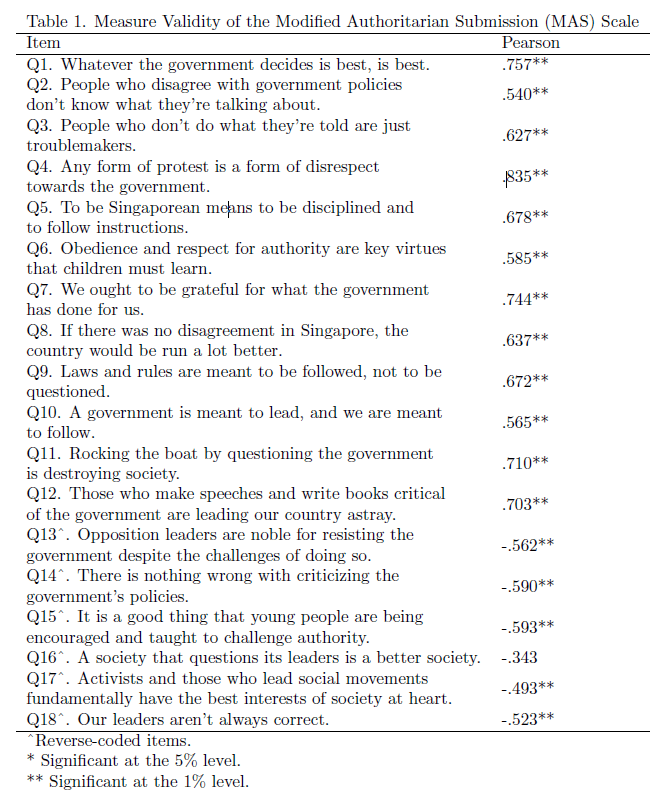
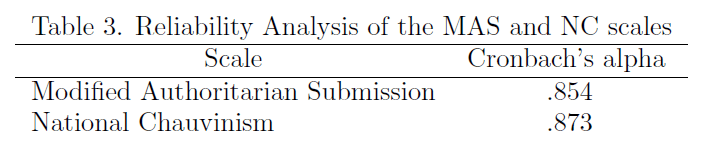
Thereafter, the reliability of the items was tested using the Cronbach’s alpha. Items Q12-18 were re-coded before running the test in order to avoid inconsistent coding. Both scales appear to be strongly reliable.
Hypothesis Testing
I shall move on to discuss the hypotheses and their outcomes. As mentioned above, three hypotheses were tested. Each of these hypotheses will be individually discussed before concluding on the results and adding further general observations.
H1: High authoritarian submission is a predictor for high national chauvinism in Singapore.
This hypothesis suggests that the higher one’s authoritarian submission, the higher one’s national chauvinism. Studying the correlation between the authoritarian submission of Singaporeans and their sense of national chauvinism is interesting because, as previous discussion indicates, most studies of aggressive nationalism focus on elite efforts to cultivate a sense of national chauvinism in their populations, to be drawn upon and readily employed when necessary. This is not always true: Duckitt & Bizumic (2013), studying the RWA, raise the example of Serbia during the overthrow of Slobodan Milošević, where Conservatism was weakly related to the other two dimensions, indicating that Serbians had developed their Authoritarian and Traditional dimensions in defiance of the prevailing institutions. It is not necessarily the case that elite control is what leads to an increase in national chauvinism. This is especially the case in Singapore, where the elite actively works to cultivate cosmopolitanism and a notional celebration of diversity in its cultural works.
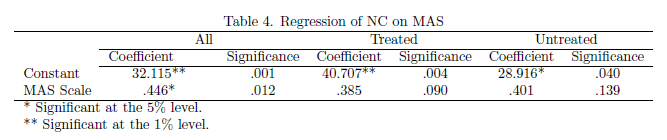
In order to assess this hypothesis, the NC was regressed on the MAS to test their relationship. The results indicated that an individual’s score on the MAS significantly predicted their score on the NC, suggesting that there was a relationship between national chauvinism and authoritarian submission. Further regressions were done controlling for whether the respondents had been treated or not. When individuals were untreated, there was no significant relationship, and when individuals were treated the relationship was weakly significant at the 10% level. Thus, it can be concluded that a general relationship exists between authoritarian submission and national chauvinism.
H2: Singaporean national music induces chauvinist feelings.
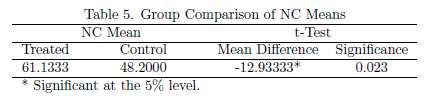
This hypothesis directly measures the power of Singapore’s music to activate the national chauvinism that other nations’ national music seems to be able to. If Singapore’s national music is able to activate a sense of chauvinism despite it not being explicitly baked into the song, it implies that respondents hold an interpretation of Singaporean nationalism that does not correspond exactly with the themes of the music and is more chauvinistic than elite constructions of Singaporean national identity. A t-test was conducted on the mean NC scores of the control and treatment groups in order to ascertain a preliminary difference, and it was determined that treated individuals tended express significantly more chauvinism than untreated individuals.
H3: The more submissive Singaporeans are, the stronger the effect of national music in inducing chauvinism.
Thus far, two conclusions have been established: firstly, that higher levels of submission predict higher levels of chauvinism, and secondly, that the treatment group had a significantly higher level of national chauvinism than the control group. I propose that, in fact, one’s level of authoritarian submission interacts with the treatment; the more submissive one is, the stronger the effect that treatment has on the national chauvinist sentiment of the individual.
In order to test this, I construct two regressions: one with and one without an interaction term computed from the product of MAS with a dummy variable signifying whether the individual had been treated or not. The two regression equations are as follows:
𝑁𝐶 = 𝛽1 ∗ 𝑇𝑟𝑒𝑎𝑡𝑚𝑒𝑛𝑡 + 𝛽2 ∗ 𝑀𝐴𝑆 + 𝛽3 ∗ 𝑀𝐴𝑆 ∗ 𝑇𝑟𝑒𝑎𝑡𝑚𝑒𝑛𝑡+ 𝑢
𝑁𝐶 = 𝛽1 ∗ 𝑇𝑟𝑒𝑎𝑡𝑚𝑒𝑛𝑡 + 𝛽2 ∗ 𝑀𝐴𝑆 + 𝑢
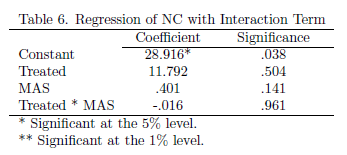
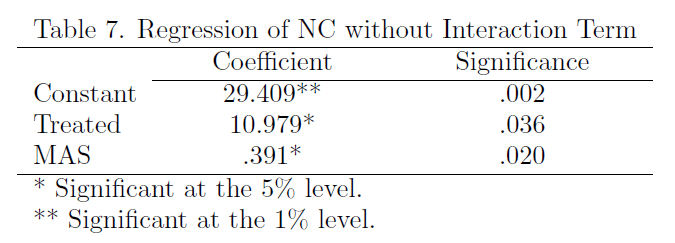
As a result of this analysis, we find that there is effectively no significant interaction between whether the individual was treated and their authoritarian submission. It cannot be concluded that higher levels of submission predict stronger treatment effects.
Discussion
The conclusion of the first hypothesis initially appears at odds with our understanding of Singaporean national identity, as theoretically a more receptive individual would be more compliant with elite constructions of Singaporean identity. To explain this, it could be fruitful question the nature of the cues that the elite passes down. If Singaporean education seeks to actively avoid inclusion of national chauvinism yet individuals who are more receptive to elite cues indicate stronger national chauvinism, is there an alternative source of cues? A theoretical explanation could be that Singaporeans are not necessarily taking their cues from what the elite says or tells them; rather, cues are being taken from policies that subtly push notions of exclusion and supremacy, standing in opposition to the values of diversity and mutual support that are notionally supported in elite messaging.
Kaur-Gill (2020) traces the development of the COVID-19 pandemic in Singapore and policy actions regarding migrant workers in Singapore. Migrant labour has been crucial to Singapore’s economy and development since the late 1970s (Lyons, 2009), and many migrant labourers suffer exploitation from employers and neglect from the state (Chin, 2019). As a result, not only do transient labour populations suffer from poor working conditions, but they are also often excluded from mainstream Singaporean society and discourse. As policy instruments actively exclude and render invisible migrant populations through heavier policing and the construction of dormitories to locate them away from society (Neo, 2015; Rudby & McKay, 2013), so too are they excluded from mainstream Singaporean civil society and regarded as inferior outsiders (Rudby & McKay, 2013; Kaur-Gill et. al., 2019).
As the COVID-19 pandemic began in Singapore, these issues would be placed under the public spotlight. 90% of individuals infected with COVID-19 in Singapore in May 2020 would be migrant construction workers, and news agencies would begin to report on the squalid living conditions that facilitated not just the rapid infection of the migrant worker community, but also the lack of spill over into the rest of Singapore’s population (Ng & Ong, 2020). Kaur-Gill (2020) demonstrates that over the course of the COVID-19 pandemic’s early development, the media would significantly frame the migrant workers as a public health threat to Singapore, notably otherizing these migrant workers through discussions of their culture and habits as implicitly contributing to their infection. Tapping on ministerial statements, a narrative of “twin outbreaks” would emerge, wherein the outbreak in the migrant community was not only framed as a Sword of Damocles hanging over Singaporean society, but also retroactively justifying their separation from mainstream Singaporean society.
Elite cues need not be explicit to elicit a response in those who are conditioned to receive elite cues. Valentino et. al. (2002) demonstrate that a wide range of implicit elite cues can be used to prime audience interpretations of different racial groups. The same, then, can be said for feelings of national chauvinism: while themes of exclusion and superiority are deliberately left out of educational material in Singapore, they are subtly transmitted regularly in mainstream discourse, and readily picked up on.
The result for second hypothesis is also curious, given the nature of Singaporean national music. As can be observed from the lyrics in Appendix 2, Singaporean national songs do not carry chauvinistic undertones at all. This implies the possibility that chauvinistic notions were instead imposed onto the songs post-hoc. Ortmann (2009) argues that many Singaporeans have adopted a more liberal sense of national identity and set of values than that propagated by the state and rely on these to contest elite formulations of national identity. I argue that the reverse is true as well: it is also possible for Singaporeans to contest national identity in the opposite direction and inject chauvinism into the mix.
Recalling Worley’s (2017) meditations on how punk rock had become ideologically hollowed-out in the United Kingdom and eventually the form became divorced from its revolutionary, left-wing roots, punk would eventually become wielded by the neo-Nazis and become heavily related to them instead (Cotter, 2007). The tonal aggression of punk rock was all too easily recast from being about rebellion against the neo-liberal establishment to being about hate. In a similar vein, I argue that the associations of Singaporean national music are no longer “pure”, in that Singaporeans’ mental associations when listening to them are no longer just the sentiments that were originally penned in them.
Finally, testing the last hypothesis yielded the result that the effectiveness of the treatment was not predicated on the submissiveness of the respondent. At the same time, the regression analysis conducted without the interaction term further validates the result obtained from analysis of the first two hypotheses: both an individual’s level of authoritarian submission and the treatment predicted higher levels of national chauvinism, but those two did not interact. This implies that the mental emotional association of Singaporean national music to national chauvinism is not mediated by how receptive the individual is to elite cues.
Limitations
The survey design and results suffered from a number of limitations.
Firstly, the survey experiment likely significantly suffered from a small sample size. A number of respondents contacted me, directly or indirectly, to inform me that the questions on the MAS and NC scales discomforted them. For a long time, the presence of Out-of-Bound (OB) markers has been a staple of Singaporean discourse, and refer to topics in civil discourse which have been earmarked as politically conscious and therefore citizens are encouraged to not discuss in a public setting (Lyons & Gomez, 2005; Fong, 2015). Given the ease of retreating from an online survey experiment, it is altogether unsurprising that many recipients who did not know who I was were unwilling to participate in the survey. It is unlikely that this situation can be remedied except perhaps through more extensive fieldwork, perhaps done physically and in-person. While more time-consuming, it would likely ensure more responses, and assuage respondents’ concerns, and given sufficient time it is likely a far larger and more representative dataset could have been collected.
Secondly, the direct impact of the treatment was not ascertained in the conventional way, i.e. the same scale being provided to respondents pre- and post-treatment. This was primarily done out of concerns that respondents would find the survey experiment too repetitive and lose interest but made data analysis difficult as one could not measure if there was any change in sentiment, but rather attempt to ascertain it through alternative analysis methods. Preferably, more creative methods could be devised to provide respondents with the same scale pre- and post-treatment without losing respondents.
Thirdly, this study lacks a qualitative element. While attitudinal surveys are undoubtedly effective at ascertaining respondents’ dispositions (Altemeyer, 1981; Duckitt & Bizumic, 2013), a more nuanced understanding of the mental and emotional connections individuals make to national music, and the beliefs they hold which contribute to these connections, could be obtained through focus group interviews instead.
Fourthly, the picture that these three hypotheses and their results paint for the relationship between Singaporean national music and national chauvinism indicate a slightly more complex landscape than initially designed for. The survey design dealt primarily with concepts and constructs surrounding Singaporean identity, while not really touching the core of what Singaporean-ness meant to people: in other words, what it meant to be a “true Singaporean”. Authoritarian submission refers to the extent to which individuals allow the elite to shape this identity for them; national chauvinism refers to the way in which individuals wield this identity; national music is a symbol signifying Singaporean identity. The initial presumption that the contours of Singaporean identity could be discussed without questioning the internal core beyond elite messaging is put into question. If the treatment is generally effective for all individuals regardless of their authoritarian submission, then it indicates that the relationship between national music and one’s national chauvinism may be mediated further by an incredibly difficult-to-define intervening variable: what exactly constitutes Singaporean-ness, the pride for which is activated by the national music.
Future Directions
Firstly, future studies can include an in-person element that was difficult to plan due to the COVID-19 restrictions. This includes not only in-person surveys, but also group singing sessions. While national music invokes strong emotions in individuals, group singing amplifies a sense of social inclusion (Welch et. al., 2014). It would be interesting to construct an experiment in which some groups are comprised entirely of Singaporeans who know each other are Singaporeans, and some groups are seeded with individuals who are identifiably non-Singaporean, and observe if sentiment differs between them.
Secondly, future studies should include batteries testing Singaporeans’ attitudes on foreign policy to substantiate the theoretical link between national chauvinism and the preference for a more aggressive foreign policy in Singapore specifically. Currently, most research on Singaporean foreign policy focuses on Singapore as a unitary actor on the world stage, and less on public opinion regarding Singapore’s management of foreign policy matters. A much broader study that investigates factors contributing to Singaporeans’ foreign policy preferences beyond simply their receptiveness to elite messaging would aid greatly in understanding the dynamics of local state-society relations.
Thirdly, a content analysis of social media to assess national chauvinist sentiment would complement this research study very well. While mainstream media is the arm through which the domestic elite propagate their notions of Singaporean identity, social media is where the alternative formulation thrives. A content analysis of the HardwareZone forum, which has been compared (unfavorably) to other infamous hotbeds of chauvinism on the internet (Chen & Frois, 2020) and which was also a major source of the CECA controversy mentioned earlier (Chan, 2021) might prove especially illuminating.
Finally, a much larger audience can be reached if this study’s elements are integrated into existing, broader surveys conducted with Singaporeans. The Lee Kuan Yew School of Public Policy (LKYSPP) last conducted the 4th run of the National Orientations of Singaporeans survey (NOS4) in 2009 (Institute of Policy Studies, 2010). With the changes in the Singaporean political landscape since then, not only is the time ripe for a fresh look at how Singaporeans view their identity, it is also a good chance to revise the themes in the study. NOS4 reported that levels of national pride were generally high and stable; it would be interesting to ascertain for the next run the more substantive attitudes underpinning this sense of national pride.
Conclusion
In semiotics16, a “floating signifier” refers to a symbol that has no fixed relationship to any object: in other words, a signifier without a signified. In coining the concept, Charles Lévi-Strauss writes:
But always and everywhere, those types of notions, somewhat like algebraic symbols, occur to represent an indeterminate value of signification, in itself devoid of meaning and thus susceptible of receiving any meaning at all; their sole function is to fill a gap between the signifier and the signified, or, more exactly, to signal the fact that in such a circumstance, on such an occasion, or in such a one of their manifestations, a relationship of non-equivalence becomes established between signifier and signified, to the detriment of the prior complementary relationship. (Lévi-Strauss, 1987: 55-56)
The conventional elite construction of Singaporean nationalism is unique on the world stage for how thin it is by comparison. Referring again to the Shared Values White Paper (Parliament of Singapore, 1991), the values listed are:
- Nation before community and society above self
- Family as the basic unit of society
- Community support and respect for the individual
- Consensus not conflict
- Racial and religious harmony
These values focus entirely on maintaining strong communities but lack any proposals for what the core of the community ought to be. If ethnic nationalists are bound together by their ethnicity, and civic nationalists are bound together by civic values, what binds Singapore together? Singaporean national music signifies Singaporean national identity. What, then, does the idea of Singaporean-ness signify?
As it turns out, nothing much. As Kong (1995), Ortmann (2009), and Lim (2015) identify, elite Singaporean nationalism is fundamentally based on the need to create a society that is simultaneously economically productive and stable. The principles that underpin national education and song, that emphasize hard work and a communal spirit, correspond to the pragmatic ideology that motivates Singaporean political practice (Tan, 2011). However, it leaves the group identity itself hollower than that of other nations, and vulnerable to contestation and capture from civil society, for better or for worse.
The research done for this thesis has demonstrated a few things. It has lent credence to the claims and observations of a nascent, exclusionary form of Singaporean national identity. In the absence of elite efforts to create a viable “core” of Singaporean identity, a subset of Singaporeans have developed their own interpretation of Singaporean identity in reaction to anxieties around the high numbers of foreign workers in Singapore. These views are not openly propagated on mainstream media, but rather cultivated on social media. Not that their efforts to do so encounter strong resistance; while cabinet ministers and members of Parliament may verbally denounce chauvinistic tendencies in domestic politics, state policy and mainstream media coverage only serve to reinforce such latent notions unintentionally.
What effects will this have someday in the future, if Singapore should ever come into conflict with a neighbouring country? Wang & Womack (2019) demonstrate the difficulties that China faces in de-securitizing an issue to its population, whose sense of national chauvinism it has cultivated and therefore presumably has greater control over. Should a situation arise in which Singapore must do the same to assuage its population for its foreign policy objectives, where can it begin?
Footnotes
[1]: Through Ortmann (2009).
[2]: The scholars, drawing upon Kohn’s dichotomy, define ethnic chauvinism as “the state of mind of a person who considers his or her people or nation to be of superior worth compared to other peoples.” (p. 64) In keeping with my analysis, I have isolated chauvinism from ethnicity to produce a definition that is amenable to more civically-minded chauvinistic nationalism.
[3]: ,,Nationalitäten entstehen nur, wenn Gemeinschaftsgruppen durch bestimmte gegenstandliche Merkmale von einander abgesondert werden.”
[4]: ,,Durch zwei fiktive Vorstellungen, denen man realen Inhalt zusprach, wurde die Nation zu einem Absolutum erhoben. Die eine besagt, daß Blut beziehungsweise Rasse die Grundlage der Nationalität sei, daß sie Ewigkeitswert besitze und ein unveränderliches Erbgut in sich trage; die andere sieht im Volksgeist den ewig sprudelnden Quell der Nationalität und ihrer Offenbarung.” Translated sections are italicized.
[5]: Altemeyer (2008) suggests that left-wing authoritarianism is plausible, but that he does not study it.
[6]: The “death of the author” is a commonly used concept in literary critique, in which any critique of a literary work is to be based entirely on the text being analysed, and that the author’s intent and biographical facts ought to hold no special weight in discerning the meaning of a text.
[7]: The company is known today by this name. Founded in 1910 as Nipponophone Co., Ltd., in 1931 it would change its name to Nippon Columbia Co., Ltd., in 1946. Contemporary Japanese people commonly refer to this company simply as “Columbia” (コロムビア).
[8]: 「一九四一(昭和十六)年七月二十八日、大本営海軍報道部第一課長平出英夫(ひらいでひらお)大佐は、丸の内の電気倶楽部(クラブ)講堂で開かれたコロムビア主催の時局講演会【高度国防国家建設と音楽の効用】(戦争と音楽)のなかで、『音楽は軍需品なり』と口走った。」
Author’s Translation: On 28 July 1941, Colonel Hiraide Hirao, Chief of the Media Division of the Navy Department in Imperial General Headquarters, attended a conference hosted by Columbia in the auditorium of the Electronics Club in the Marunouchi district of Tokyo. He would give a lecture on the contemporary situation titled “The Effectiveness of Music on National Defence and Nation-Building (War and Music)”, where he would quip, “music has become a military supply.”
[9]: 「民衆は楽しみ、企業は儲かり、当局は効率的に仕事ができる。こうして三社の利害が一致し、軍歌は官民挙げての国民的なエンターテインメントと化した。当時も今も、老若男女、貴賤を問わずに消費されるこのような娯楽を他に見いだすことは難しい。その意味で軍歌は、日本史上最大のエンタメだったとさえいえるのではないだろうか。」
Author’s Translation: The people enjoy themselves, business prosper, and the authorities could fulfil their objectives effectively. In this way, with the interests of the three sectors aligning, Gunka became a form of entertainment that united the public and private sectors. Then, as now, it is difficult to find forms of entertainment that can be consumed regardless of age, gender, or socio-economic status. It is in this sense that Gunka could perhaps be viewed as the greatest form of entertainment in Japanese history.
[10]: The 国体 (kokutai), or “national body” refers to the core civilizational essence of Japan. Proposed by Katou Hiroyuki and Fukuzawa Yukichi in 1874 and 1875, the kokutai was to be distinguished from the 政体 (seitai), or “government body”. It proposed an essentialist understanding of Japanese identity, consisting typically of the systems of rituals and customs surrounding the Emperor who was said to embody Japan itself, while simultaneously suggesting that the various forms of Japanese governance in history (Imperial rule, regent rule, Shogunate rule, constitutional monarchy, etc.) were merely arrangements regarding the exercise of political authority. As time progressed, the concept of the kokutai would gain stronger and stronger mythological dimensions, culminating in the publication of the pamphlet. In the editorial introduction to the 1949 translation of 国体の本義, Robert King Hall writes, “It was inevitable that the Kokutai no Hongi should be compared with Adolf Hitler’s Mein Kampf, the basic blueprint of German totalitarianism and aggression… Hitler’s emotional retreat into the mythology of ancient German culture was never a vital part of his political thinking. His plan of conquest was cynically realistic. His propaganda machine devised, tested, and applied aberrant ideas with the same unemotional precision that his scientists exhibited in creating physical weapons. Few, if any, of his more important followers paid more than perfunctory lip service to this mythology. The Kokutai no Hongi is a literary expression of ideas equally aberrant but sincerely held by a very great majority of the Japanese. It is futile to argue that “intelligent” Japanese could not possibly believe such propaganda. This document and similar ones produced after the rise of the militarists to power in the middle 1930’s may be more emotional, more vehement than earlier scholarly works, but it is based on an identical belief in the divine origin of Japan, its people, and its ruling family.” (Hall, 1949: 7-8)
[11]: Khan (2020) aggregates the social media discourse surrounding CECA. While it would be an interesting discussion to unpack the implications of mostly Chinese Singaporeans levelling a blanket charge against the Indian community and trying to navigate the difficulty most have with distinguishing between “Singaporean Indians” and “Indian Indians”, which is what the vast majority of the discussion would often focused on, the question of what this implies for future Singaporean economic cooperation with its neighbours is also relevant.
[12]: Minister Ong Ye Kung: “Indeed, Singaporean PMEs, like PMEs in other advanced economies, are facing challenges. Many have given us their feedback and the Government has been taking steps to address their concerns. But our FTAs in general, and CECA in particular, are not the cause of the challenges our PMEs face. If anything, they are part of the solution. FTAs and CECA have been made political scapegoats to discredit the policy of the PAP Government.”
[13]: Minister Ong Ye Kung: “Let me first recapitulate how we got here. As I mentioned, for months now, the PSP has alleged that FTAs and CECA have led to the unfettered inflow of Indian professionals, displacing Singaporeans from their jobs and bringing about all kinds of social ills. This is a seductively simplistic argument that workers facing challenges at their workplaces can identify with and has stirred up a lot of emotions. CECA-themed websites have sprouted, filled with quite disturbing xenophobic views about Indian immigrants. Words gradually became deeds. Toxic views turned into verbal and physical assaults on Indians, including our citizens.”
[14]: To borrow the example of Japan, Tsujita (2015) raises the example of the poem 抜刀隊/Battoutai (Drawn-Sword Regiment), written by Meiji-era sociologist Toyama Masakazu. Battoutai is commonly referred to as the first Western-style military song in Japan, and when Toyama published the poem in the 8th volume of the 東洋学芸雑誌 (Author’s Translation: Asia-Pacific Journal of Education and Culture), he made this connection rather explicitly. Accompanying the poem, he wrote the following: 「西洋にてハ戦の時、慷慨激烈なる歌を謡ひて、士気を励ますことあり。即ち仏人の革命のとき、『マルセール』と云へる最と激烈なる歌を謡ひて進撃し、普仏戦争の時普人の『ウオツチメン、オン、ぜ、ライン』と云へる歌を謡ひて愛国心を励ませし如し、皆此類なり。左の抜刀隊の歌ハ即ち此例し効ひたるものなり。」(Taken from Tsujita, 2015: 20)
Author’s Translation: “When the West goes to war, through singing songs of righteous indignation and fervor, the morale of the soldiers would be bolstered. For example, the song La Marseillaise was written during the French revolution to articulate the passionate fury of the people in their march forward, and during the Franco-Prussian War the song Die Wacht am Rhein was written to bolster the sense of patriotism in the citizens of Germany. Many such examples exist. I hope that Battoutai, on the left, will be comparatively as effective as those songs.”
[15]: 1 – Strongly disagree; 2 – Disagree; 3 – Somewhat disagree; 4 – Neither agree nor disagree; 5 – Somewhat agree; 6 – Agree; 7 – Strongly agree.
[16]: The study of the creation and communication of meaning.
References
Acharya, A. (2008). Singapore’s Foreign Policy: The Search for Regional Order. World Scientific Publishing Co. Pte. Ltd.
Adorno, T. W., Frenkel-Brunswick, E., Levinson, D. J., & Sanford, R. N. (1969). The Authoritarian Personality (3rd Printing, Vol. 1). Norton.
Altemeyer, B. (1981). Right-Wing Authoritarianism. University of Manitoba Press.
Altemeyer, B. (2008). The Authoritarians. Cherry Hill Publishing.
Anderson, B. (2006). Imagined Communities: Reflections on the Origin and Spread of Nationalism (Revised). Verso.
Baudrillard, J. (n.d.). Simulacra and Simulation (S. F. Glaser, Trans.).
Blum, S. (2010). Musical Enactment of Attitudes toward Conflict in the United States. In J. M. O’Connell & S. E.-S. Castelo-Branco (Eds.), Music and Conflict (pp. 232–242). University of Illinois Press.
Bonikowski, B. (2016). Nationalism in Settled Times. Annual Review of Sociology, 42, 427–449. https://doi.org/10.1146/annurev-soc-081715-074412
Brighouse, H. (2003). Should We Teach Patriotic History? In K. McDonough & W. Feinberg (Eds.), Citizenship and Education in Liberal-Democratic Societies: Teaching for Cosmopolitan Values and Collective Identities (pp. 157–178). Oxford University Press.
Brincker, B., & Brincker, J. (2004). Musical constructions of nationalism: A comparative study of Bartók and Stravinsky. Nations and Nationalism, 10(4), 579–597. https://doi.org/10.1111/j.1354-5078.2004.00183.x
Burcu, O. (2021). The Chinese government’s management of anti-Japan nationalism during Hu-Wen era. International Relations of the Asia-Pacific, 1–30. https://doi.org/10.1093/irap/lcab002
Chan, M. (2021, February 24). Are there really 650,000 Overseas Indians in Singapore? Black Dot Research. https://blackdotresearch.sg/are-there-really-650000-overseas-indians-in-singapore/
Chen, J., & Frois, A. (2020, June 23). Is Singapore’s Pervert Problem Getting Worse? Vice. https://www.vice.com/en/article/4ay39n/singapores-pervert-problem-getting-worse
Chew, J. O. A. (1998). Civics and Moral Education in Singapore: Lessons for citizenship education? Journal of Moral Education, 27(4), 505–524. https://doi.org/10.1080/0305724980270405
Chia, Y.-T. (2015). Education, Culture and the Singapore Developmental State: “World-Soul” Lost and Regained? Palgrave Macmillan.
Chin, C. (2019). Precarious Work and its Complicit Network: Migrant Labour in Singapore. Journal of Contemporary Asia, 49(4), 528–551. https://doi.org/10.1080/00472336.2019.1572209
Chong, A. (2006). Singapore’s foreign policy beliefs as “Abridged Realism”: Pragmatic and liberal prefixes in the foreign policy thought of Rajaratnam, Lee, Koh, and Mahbubani. International Relations of the Asia-Pacific, 6(2), 269–306.
Clammer, J. (1985). Singapore: Ideology, Society, and Culture. Chopmen Publishers.
Cotter, J. M. (1999). Sounds of hate: White power rock and roll and the neo‐nazi skinhead subculture. Terrorism and Political Violence, 11(2), 111–140. https://doi.org/10.1080/09546559908427509
Dancs, K., & Fülöp, M. (2020). Past and present of social science education in Hungary. Journal of Social Science Education, 19(1), 47–71. https://doi.org/10.4119/jsse-3273
Dikici, E. (2022). Nationalism is dead, long live nationalism! In pursuit of pluralistic nationalism: A critical overview. Ethnicities, 22(1), 146–173. https://doi.org/10.1177/14687968211063694
Donovan, T. (2021). Right populist parties and support for strong leaders. Party Politics, 27(5), 858–869. https://doi.org/10.1177/1354068820920853
Duckitt, J., & Bizumic, B. (2013). Multidimensionality of Right-Wing Authoritarian Attitudes: Authoritarianism-Conservatism-Traditionalism. Political Psychology, 34(6), 841–862. https://doi.org/10.1111/pops.12022
Eyerman, R., & Jamison, A. (1998). Music and Social Movements: Mobilizing Traditions in the Twentieth Century. Cambridge University Press.
Fong, S. Y. (2015). Censorship as Performance: A Case of Singapore Media Production. In E. Thorsen, H. Savigny, J. Alexander, & D. Jackson (Eds.), Media, Margins and Popular Culture (pp. 202–215). Palgrave Macmillan UK. https://doi.org/10.1057/9781137512819_14
Gellner, E. (1983). Nations and Nationalism. Cornell University Press.
Guisinger, A., & Saunders, E. N. (2017). Mapping the Boundaries of Elite Cues: How Elites Shape Mass Opinion across International Issues. International Studies Quarterly, 61(2), 425–441. https://doi.org/10.1093/isq/sqx022
Habermas, J. (1998). The Inclusion of the Other: Studies in Political Theory (C. Cronin & P. de Greiff, Eds.). The MIT Press.
Hall, R. K. (Ed.). (1949). Kokutai no Hongi: Cardinal Principles of the National Entity of Japan (J. O. Gauntlett, Trans.). Harvard University Press.
Hallin, D. C. (1984). The Media, the War in Vietnam, and Political Support: A Critique of the Thesis of an Oppositional Media. The Journal of Politics, 46(1), 2–24. https://doi.org/10.2307/2130432
Herman, E. S., & Chomsky, N. (2008). Manufacturing Consent: The Political Economy of the Mass Media (3rd ed.). The Bodley Head.
Hill, M., & Lian, H. F. (1995). The Politics of Nation Building and Citizenship in Singapore. Routledge.
Ho, A. (2016). The Invention of Tradition: Nationalist Songs and Nation-Building in Singapore [Bachelor, National University of Singapore]. https://scholarbank.nus.edu.sg/handle/10635/187298
Ho, L.-C. (2012). Sorting citizens: Differentiated citizenship education in Singapore. Journal of Curriculum Studies, 44(3), 403–428. https://doi.org/10.1080/00220272.2012.675359
Hobsbawm, E., & Ranger, T. (Eds.). (2013). The Invention of Tradition (21st Print Edition). Cambridge University Press.
Howard, K. (2010). Music Across the DMZ. In J. M. O’Connell & S. E.-S. Castelo-Branco (Eds.), Music and Conflict (pp. 67–88). University of Illinois Press.
Hung, C.-T. (1996). The Politics of Songs: Myths and Symbols in the Chinese Communist War Music, 1937-1949. Modern Asian Studie, 30(4), 901–929. https://doi.org/10.1017/S0026749X00016838
Institute of Policy Studies. (2010). Citizens and the Nation: National Orientations of Singaporeans Survey (NOS4). Institute of Policy Studies. https://lkyspp.nus.edu.sg/docs/default-source/ips/cnp__pol_part_survey_media_release_report_3007_for_ppts11.pdf
Kaur-Gill, S. (2020). The COVID-19 Pandemic and Outbreak Inequality: Mainstream Reporting of Singapore’s Migrant Workers in the Margins. Frontiers in Communication, 5. https://www.frontiersin.org/article/10.3389/fcomm.2020.00065
Kaur-Gill, S., Pandi, A. R., & Dutta, M. J. (2021). Singapore’s national discourse on foreign domestic workers: Exploring perceptions of the margins. Journalism, 22(12), 2991–3012. https://doi.org/10.1177/1464884919879850
Khan, A. U. (2020, October 8). Why Have Singaporeans Turned Against Indian Professionals? The Diplomat. https://thediplomat.com/2020/10/why-have-singaporeans-turned-against-indian-professionals/
Kohn, H. (1962). Die Idee des Nationalismus: Ursprung und Geschichte bis zur Französischen Revolution (G. Nast-Kölb, Trans.). S. Fischer Verlag.
Kong, L. (1995). Music and Cultural Politics: Ideology and Resistance in Singapore. Transactions of the Institute of British Geographers, 20(4), 447–459. https://doi.org/10.2307/622975
Kong, L. (2007). Civil religion and the invention of traditions: Constructing “the Singapore nation.” Australian Religious Studies Review, 20(1), 77–93. https://doi.org/10.1558/arsr.v20i1.77
Kratochvíl, M. (2015). “Our Song!” Nationalism in Folk Music Research and Revival in Socialist Czechoslovakia. Studia Musicologica, 56(4), 397–406.
Lévi-Strauss, C. (1987). Introduction to the Work of Marcel Mauss (F. Baker, Trans.). Routledge.
Lim, J. (2015). Popular Nationalism in the Wake of the 2011 National Elections in Singapore. Japanese Journal of Political Science, 16(2), 143–159. https://doi.org/10.1017/S146810991500002X
Lyons, L. (2009). Transcending the Border: Transnational Imperatives in Singapore’s Migrant Worker Rights Movement. Critical Asian Studies, 41(1), 89–112. https://doi.org/10.1080/14672710802631178
Lyons, L., & Gomez, J. (2005). Moving Beyond the OB Markers: Rethinking the Space of Civil Society in Singapore. Sojourn: Journal of Social Issues in Southeast Asia, 20(2), 119–131.
Manabe, N. (2012). Songs of Japanese Schoolchildren during World War II. In P. S. Campbell & T. Wiggins (Eds.), The Oxford Handbook of Children’s Musical Cultures (pp. 96–114). Oxford University Press.
Neo, J. L. (2015). Riots and Rights: Law and Exclusion in Singapore’s Migrant Worker Regime. Asian Journal of Law and Society, 2(1), 137–168. https://doi.org/10.1017/als.2015.1
Ng, J. S., & Ong, J. (2020, May 11). The Big Read: Solving Singapore’s foreign workers problem requires serious soul searching, from top to bottom. Channel News Asia.
O’Connell, J. M. (2010). An Ethnomusicological Approach to Music and Conflict. In J. M. O’Connell & S. E.-S. Castelo-Branco (Eds.), Music and Conflict (pp. 1–14). University of Illinois Press.
Olmechenko, D., Maximova, S., Avdeeva, G., Goncharova, N., Noyanzina, O., & Surtaeva, O. (2015). Patriotic education and civic culture of youth in Russia: Sociological perspective. Procedia – Social and Behavioral Sciences, 190, 364–371. https://doi.org/10.1016/j.sbspro.2015.05.012
Ong, X. L., & Cheung, H. S. (2016). Schools and the Class Divide: An Examination of Children’s Self-Concept and Aspirations in Singapore (Research Monograph No. 11; p. 131). Singapore Children’s Society.
Ortmann, S. (2009). Singapore: The Politics of Inventing National Identity. Journal of Current Southeast Asian Affairs, 28(4), 23–46. https://doi.org/10.1177/186810340902800402
Parliament of Singapore. (1991). White Paper on Shared Values (Command Paper Cmd. 1 of 1991). Parliament. https://www.nas.gov.sg/archivesonline/government_records/docs/a487bfde-7aea-11e7-83df-0050568939ad/Cmd.1of1991.pdf
Parliament of Singapore. (2021a). Free Trade Agreements and Foreign Manpower (Official Report 95(32); Singapore Parliamentary Debates). Parliament of Singapore. https://sprs.parl.gov.sg/search/fullreport?sittingdate=06-07-2021
Parliament of Singapore. (2021b). Impact of Singapore-India Comprehensive Economic Cooperation Agreement on Trade, Job Growth, Employment of Singaporeans (Official Report 95(32); Singapore Parliamentary Debates). Parliament of Singapore. https://sprs.parl.gov.sg/search/fullreport?sittingdate=06-07-2021
Passini, S. (2017). Different Ways of Being Authoritarian: The Distinct Effects of Authoritarian Dimensions on Values and Prejudice. Political Psychology, 38(1), 73–86.
Rubdy, R., & McKay, S. L. (2013). “Foreign workers” in Singapore: Conflicting discourses, language politics and the negotiation of immigrant identities. International Journal of the Sociology of Language, 2013(222), 157–185. https://doi.org/10.1515/ijsl-2013-0036
Sabet-Esfahani, S. (2014). Prejudice and Protectionism: Essays at the Intersection of International Political Economy and Psychology [Doctoral Dissertation, Harvard University]. https://dash.harvard.edu/bitstream/handle/1/12274615/Sabet_gsas.harvard_0084L_11687.pdf
Stilz, A. (2009). Civic Nationalism and Language Policy. Philosophy & Public Affairs, 37(3), 257–292.
Sweers, B. (2010). Music against Fascism: Applied Ethnomusicology in Rostock, Germany. In J. M. O’Connell & S. E.-S. Castelo-Branco (Eds.), Music and Conflict (pp. 193–213). University of Illinois Press.
Szabó, I. K. (2018). Youth and National Defence in Hungary. Hadtudomanyi Szemle/Military Science Review, 11(1), 199–207.
Tamir, Y. (Yuli). (2019). Not So Civic: Is There a Difference Between Ethnic and Civic Nationalism? Annual Review of Political Science, 22, 419–434. https://doi.org/10.1146/annurev-polisci-022018-024059
Tan, K. P. (2012). The Ideology of Pragmatism: Neo-liberal Globalisation and Political Authoritarianism in Singapore. Journal of Contemporary Asia, 42(1), 67–92. https://doi.org/10.1080/00472336.2012.634644
Tan, T. W., & Chew, L. C. (2004). Moral and citizenship education as statecraft in Singapore: A curriculum critique. Journal of Moral Education, 33(4), 597–606. https://doi.org/10.1080/0305724042000315644
Thangam, K. (2015). The Population White Paper: The hidden rationale for Singaporeans’ concern. HSSE Online, 4(2), 107–119.
The President’s Advisory 1776 Commission. (2021). The 1776 Report (p. 41) [Advisory Report]. United States White House. https://trumpwhitehouse.archives.gov/wp-content/uploads/2021/01/The-Presidents-Advisory-1776-Commission-Final-Report.pdf
Tischmeyer, C. (2021). Exclusive citizenship as basis for chauvinistic nationalism: A historical institutionalist perspective on the ruling rationales of liberal regimes. In M. Bayer, O. Schwarz, & T. Stark (Eds.), Democratic Citizenship in Flux: Conceptions of Citizenship in the Light of Political and Social Fragmentation (Vol. 85, pp. 23–42). transcript Verlag. https://doi.org/10.14361/9783839449493-002
Tsujita, M. (2015). 日本の軍歌:国民的音楽の歴史 (3rd ed.). Gentosha Inc.
Tyrrell, M. (1996). Nation‐states and states of mind: Nationalism as psychology. Critical Review, 10(2), 233–250. https://doi.org/10.1080/08913819608443419
Valentino, N. A., Hutchings, V. L., & White, I. K. (2002). Cues that Matter: How Political Ads Prime Racial Attitudes During Campaigns. American Political Science Review, 96(1), 75–90.
Van Cleemput, G., & Nieli, R. (1995). Clarifying Nationalism, Chauvinism, and Ethnic Imperialism. International Journal on World Peace, 12(1), 59–97.
Wang, F. Y. (2021). Barking without biting: Understanding Chinese media campaigns during foreign policy disputes. Security Studies, 1–41. https://doi.org/10.6084/m9.figshare.14459172
Wang, F. Y., & Womack, B. (2019). Jawing through Crises: Chinese and Vietnamese Media Strategies in the South China Sea. Journal of Contemporary China, 28(119), 712–728. https://doi.org/10.1080/10670564.2019.1580429
Welch, G. F., Himonides, E., Saunders, J., Papageorgi, I., & Sarazin, M. (2014). Singing and social inclusion. Frontiers in Psychology, 5. https://www.frontiersin.org/article/10.3389/fpsyg.2014.00803
Wiegand, K. E. (2005). Nationalist Discourse and Domestic Incentives to Prevent Settlement of the Territorial Dispute Between Guatemala and Belize. Nationalism and Ethnic Politics, 11(3), 349–383. https://doi.org/10.1080/13537110500255486
Worley, M. (2017). No Future: Punk, Politics, and British Youth Culture, 1976-1984. Cambridge University Press.
Young, D. (2013). The Party Line: How the Media Dictates Public Opinion in Modern China. John Wiley & Sons Singapore Pte. Ltd.
Zhang, S. I. (2020). Media and Conflict in the Social Media Era in China. Palgrave Macmillan.
Zhao, S. (1998). A State-Led Nationalism: The Patriotic Education Campaign in Post-Tiananmen China. Communist and Post-Communist Studies, 31(3), 287–302.
 Belle's Hell